

Liliesleaf and the Farm That Hid a Revolution.
There is a particular kind of quiet that settles over a place once the danger has left it. Liliesleaf Farm, in the leafy Johannesburg suburb of Rivonia, has that quiet now. Birdsong in the jacarandas. A red-brick path curling between whitewashed outbuildings with their thatched roofs pulled low like caps against the sun. Visitors move through it at the unhurried pace of people reading interpretation panels, pausing at a plaque here, a reconstructed room there. It feels, on a bright morning, almost domestic.
That is precisely what it was built to feel like. And it is precisely what made it work.
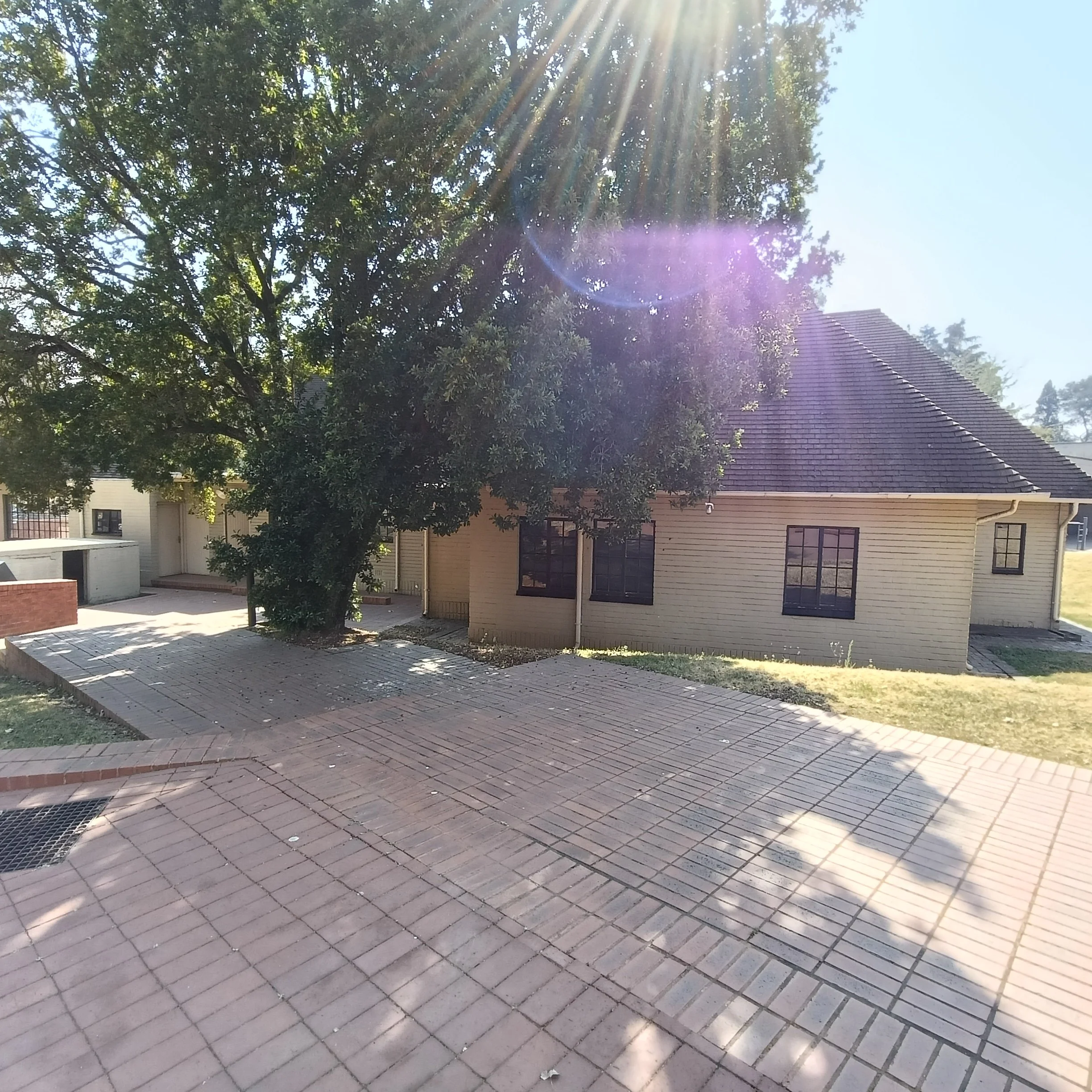
The main farmhouse at Liliesleaf, Rivonia, with the winter sun breaking through the trees.
For a little under two years, between 1961 and July 1963, this unremarkable smallholding was the underground nerve centre of South Africa's liberation movement. It was where Nelson Mandela lived in hiding, disguised as a groundsman. It was where the High Command of Umkhonto we Sizwe, the newly formed armed wing of the African National Congress, met to plan a campaign of sabotage against the apartheid state. It was where a document called Operation Mayibuye was drafted, a plan so serious in its implications that its discovery would help send men to prison for the rest of their working lives. And on the afternoon of 11 July 1963, it was where the state finally caught up with them.
I want to walk you through Liliesleaf the way I walked it myself: not as a museum with a gift shop at the end, though it is that too, but as a piece of ground that still remembers what happened on it. Every panel, every plaque, every reconstructed room I photographed there is a fragment of a much larger story, and it is a story that deserves more than the ninety minutes most visitors give it.
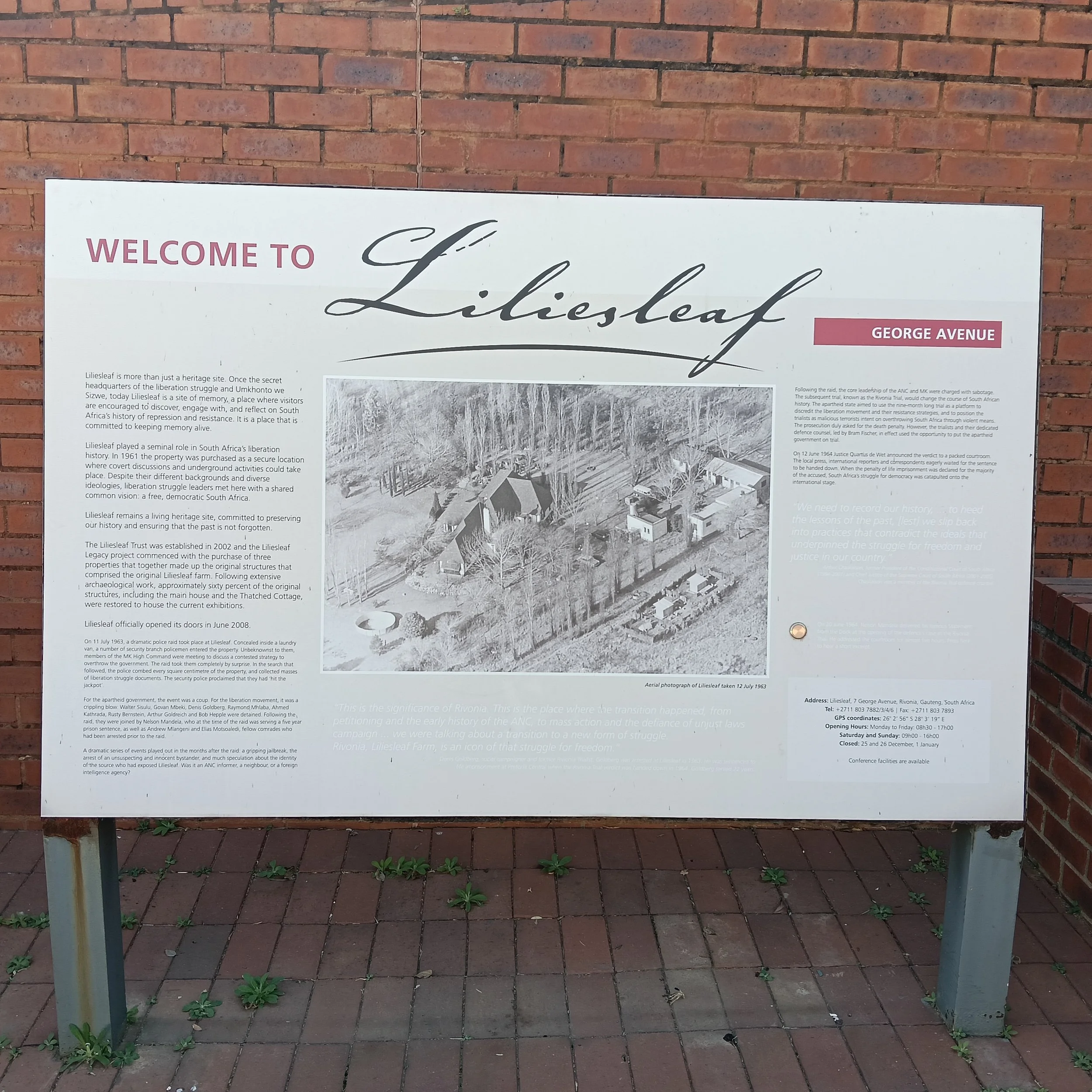
The entrance panel on George Avenue, where every visit to Liliesleaf begins.
A Farm Bought to Disappear Into.
By 1961, the African National Congress had been banned for a year. The Sharpeville Massacre of March 1960, when police opened fire on a crowd protesting the pass laws and killed sixty-nine people, had convinced the movement's leadership that the long tradition of passive resistance stretching back to Gandhi's Satyagraha campaigns of 1906 had reached the limit of what it could achieve against a state willing to shoot unarmed civilians in the back. Non-violence had been a moral position and a strategic one. Now it looked, to men like Mandela, like a slow form of surrender.
The timeline panels at Liliesleaf lay this out with a clarity that the museum clearly wants visitors to sit with. Passive Resistance, 1906 to 1946. Resistance, 1948 to 1952, tracking the National Party's election victory and the rapid legislative construction of apartheid. Turning Point, 1960 to 1966, the hinge years: Sharpeville, Oliver Tambo slipping out of the country to build the external mission, and the formation of MK itself in 1961. The Change Begins, 1976 to 1994, the long road from the Soweto uprising to democracy. Reading them in sequence on that brick path, you understand the shape of an argument before you ever reach the farm buildings: that Liliesleaf did not appear from nowhere. It was the answer to a question the state had spent a decade forcing the ANC to ask itself.
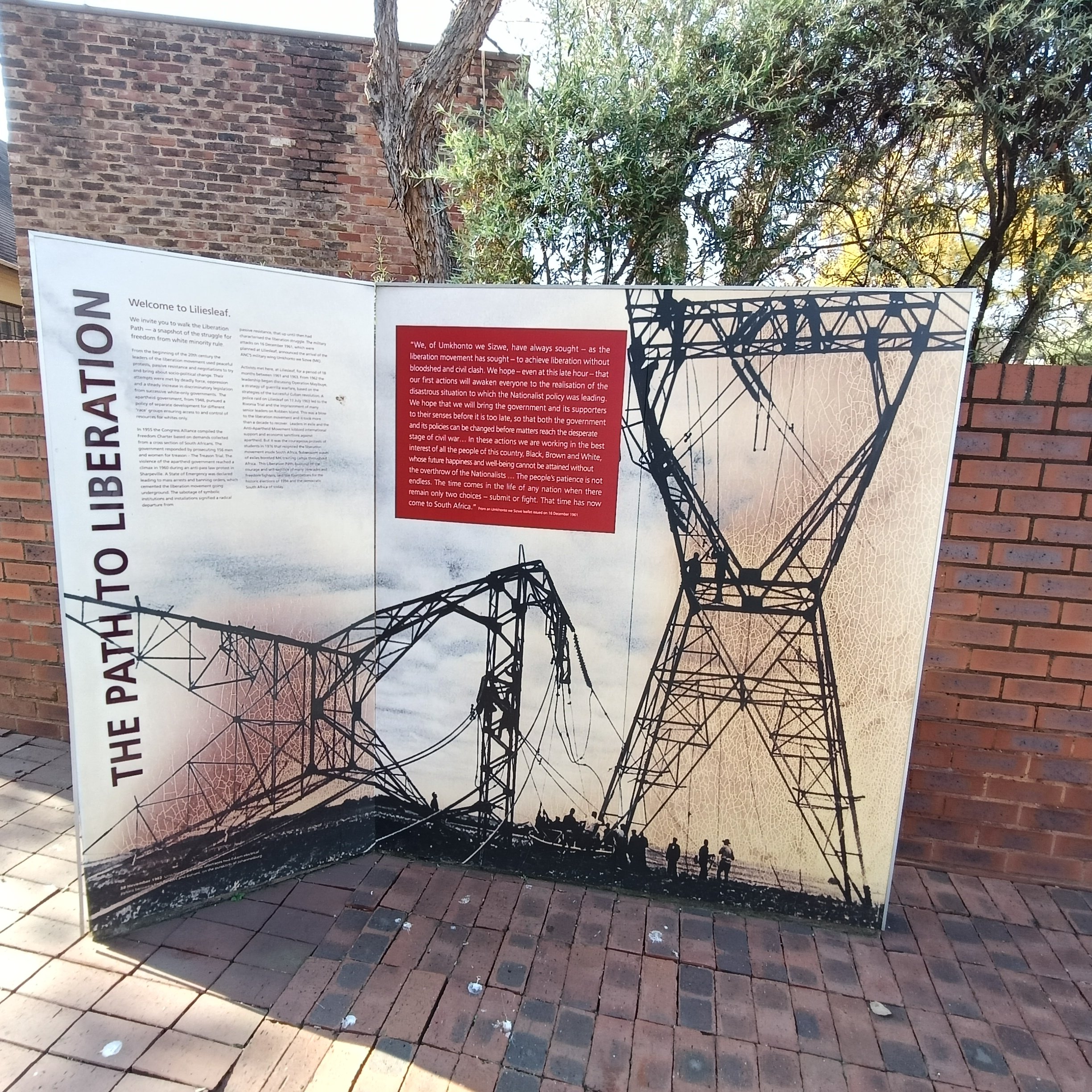
The Path to Liberation: the outdoor timeline wall that frames the whole site.
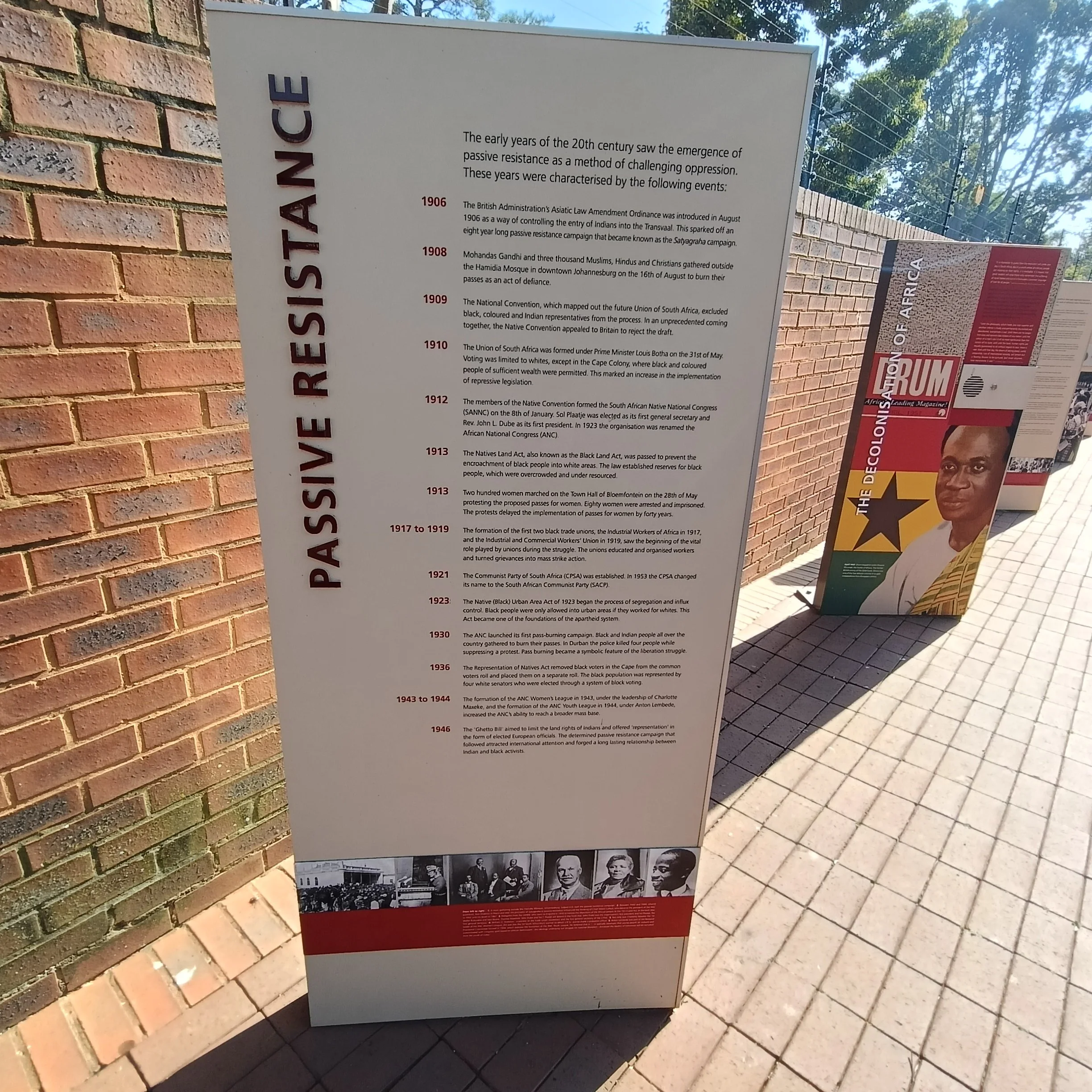
Passive Resistance, 1906 to 1946.
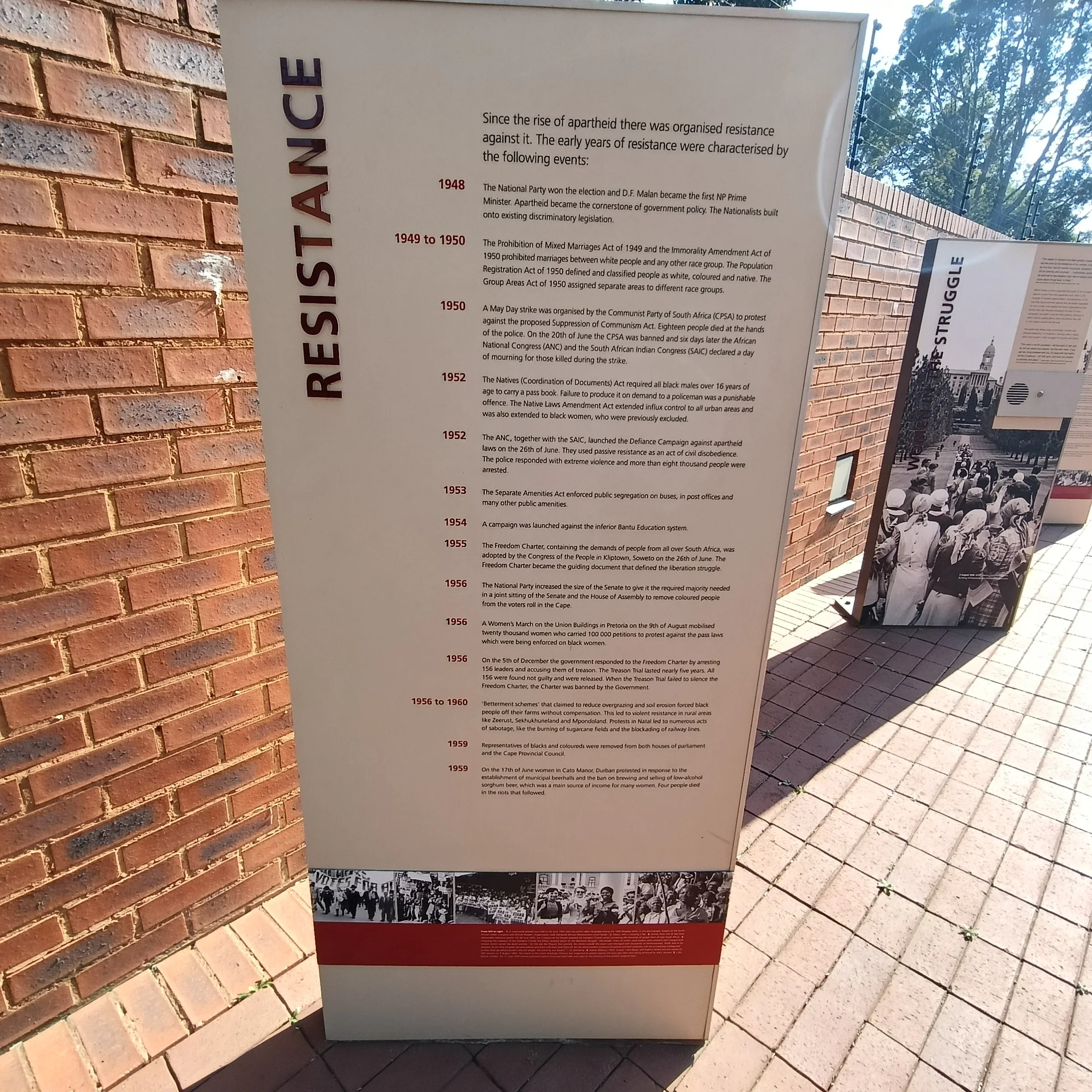
Resistance, 1948 to 1952: the legal architecture of apartheid.
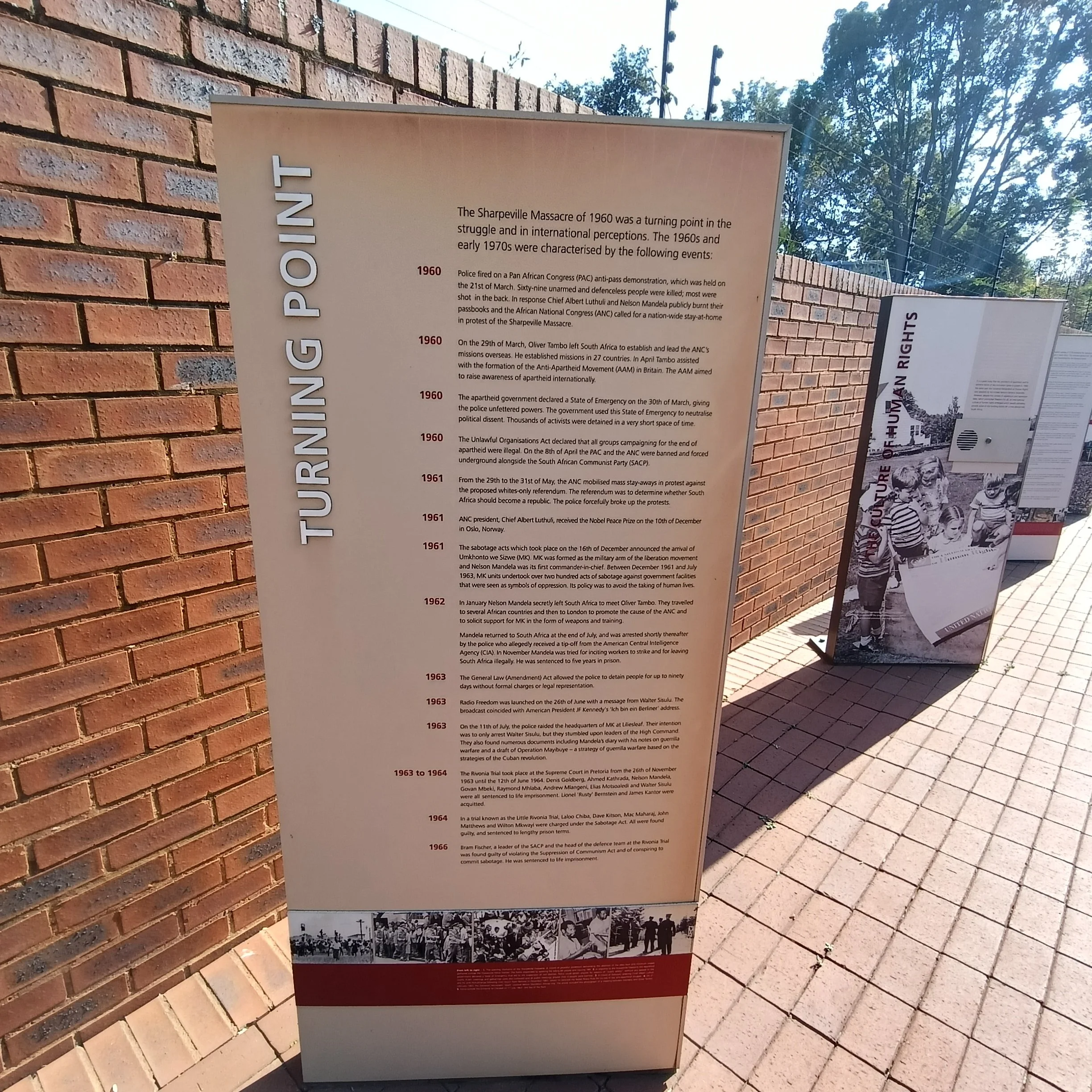
Turning Point, 1960 to 1966: Sharpeville, the banning of the ANC and the birth of MK.
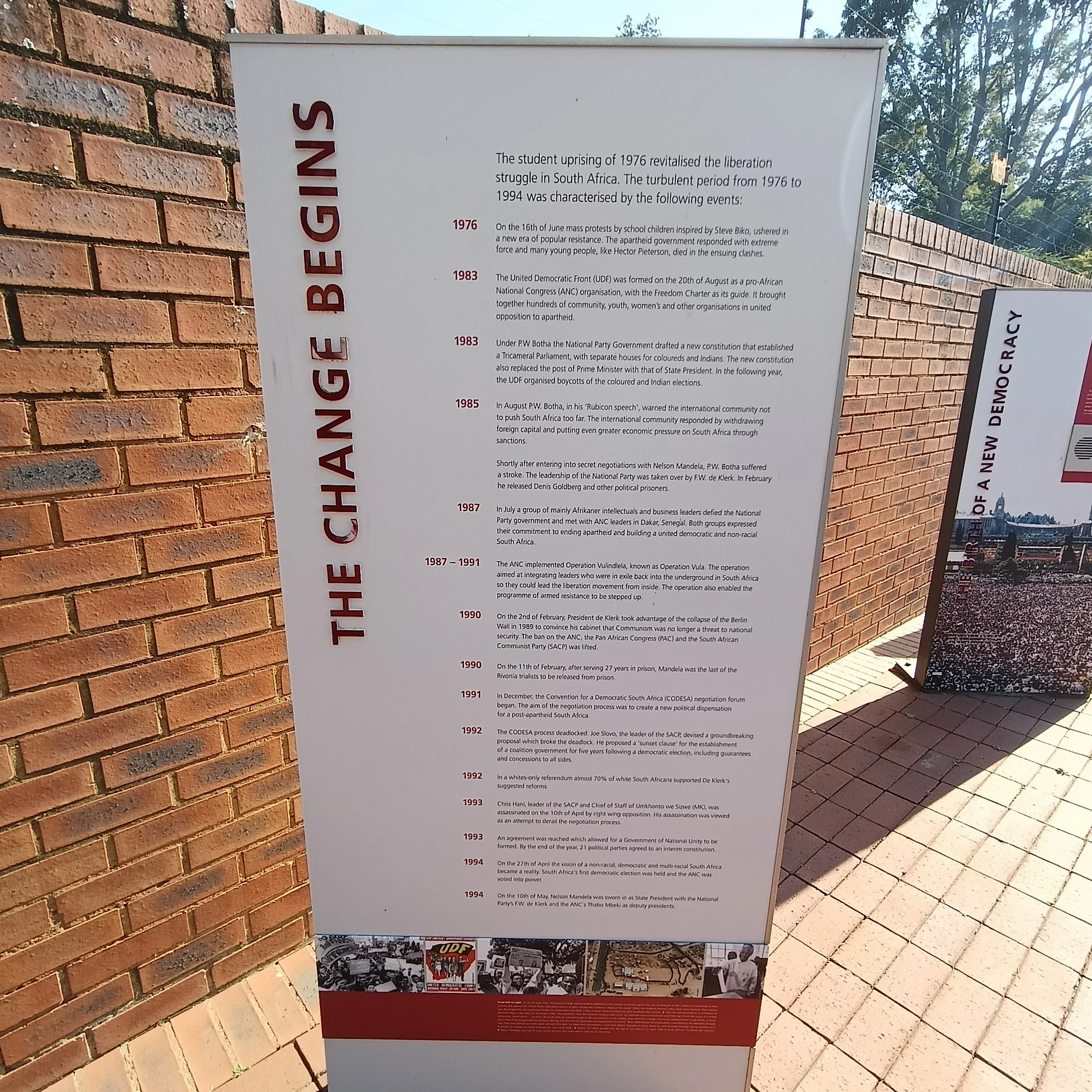
The Change Begins, 1976 to 1994.
The farm needed to be invisible, which meant it needed a story. It was bought through a front, registered to make it look like the property of a white family with no political history at all. Arthur Goldreich, an artist and former Palmach fighter with a talent for reinvention, moved in with his family and played the part of the owner to neighbours and tradesmen. Nelson Mandela, already living underground and dodging the police as the country's most wanted man, took a job on the same property under the name David Motsamayi, presenting himself as the family's gardener and general help. He wore overalls. He fetched groceries. He was, for the length of his stay, invisible in the particular way that black South Africans doing manual labour on white-owned land were invisible to a state that had built an entire legal architecture out of not truly seeing them. The disguise worked because the state's own racism was the biggest gap in its surveillance.
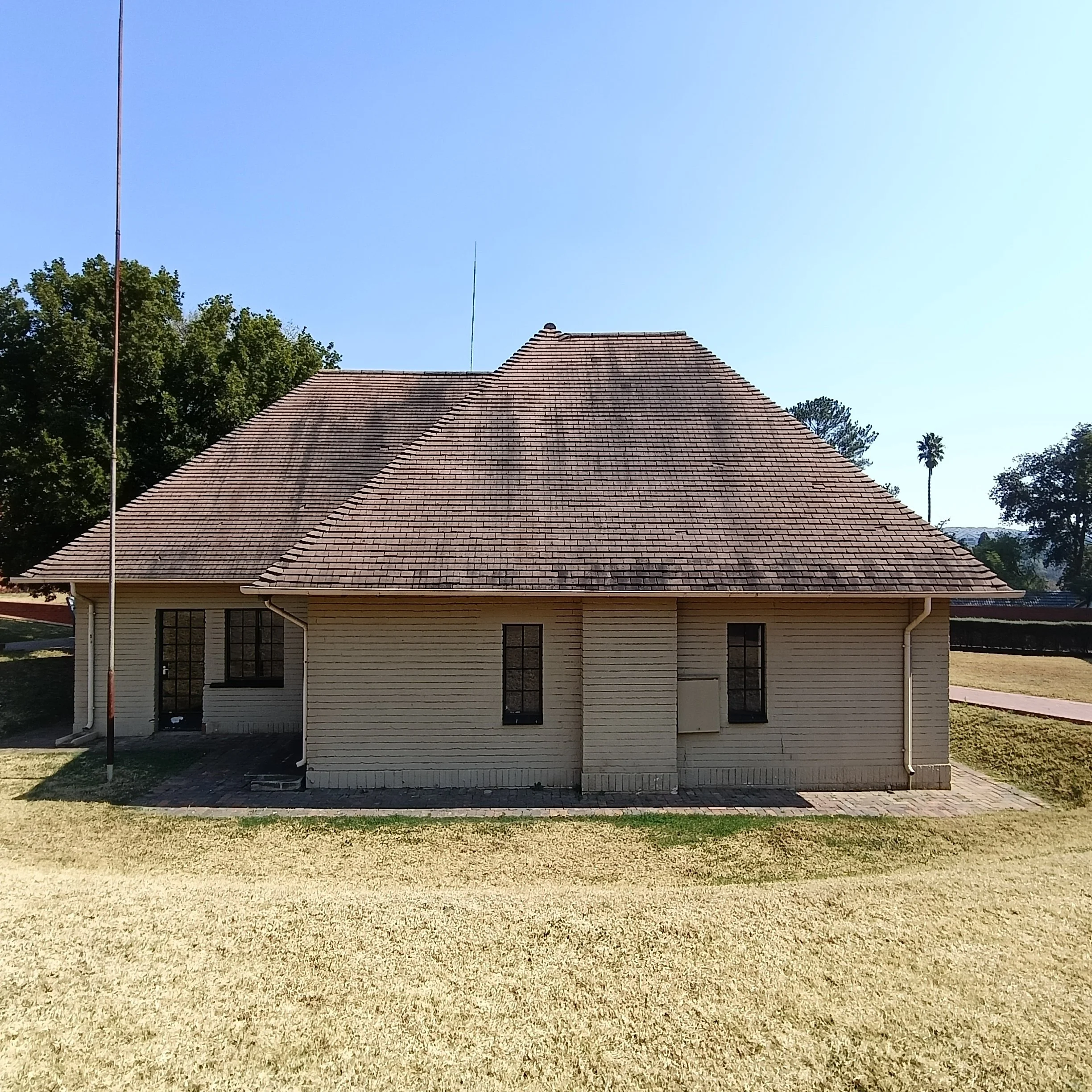
The thatched farmhouse that played its part as an ordinary family home.
Underneath that ordinary surface, the outbuildings became a meeting place for the MK High Command: Walter Sisulu, Govan Mbeki, Raymond Mhlaba, Ahmed Kathrada, and others, moving in and out under cover, planning a campaign that would eventually range from acts of sabotage against infrastructure to, in the draft plan found at the farm, contemplation of a full guerrilla insurgency. The "Liliesleaf Farm: Secret Meetings and Safe House" panel inside the main house tells this part of the story in the museum's own words, and it is worth reading slowly, because the ordinary vocabulary of estate agency, a purchase, a lease, a caretaker, sits so strangely against what was actually being planned inside.
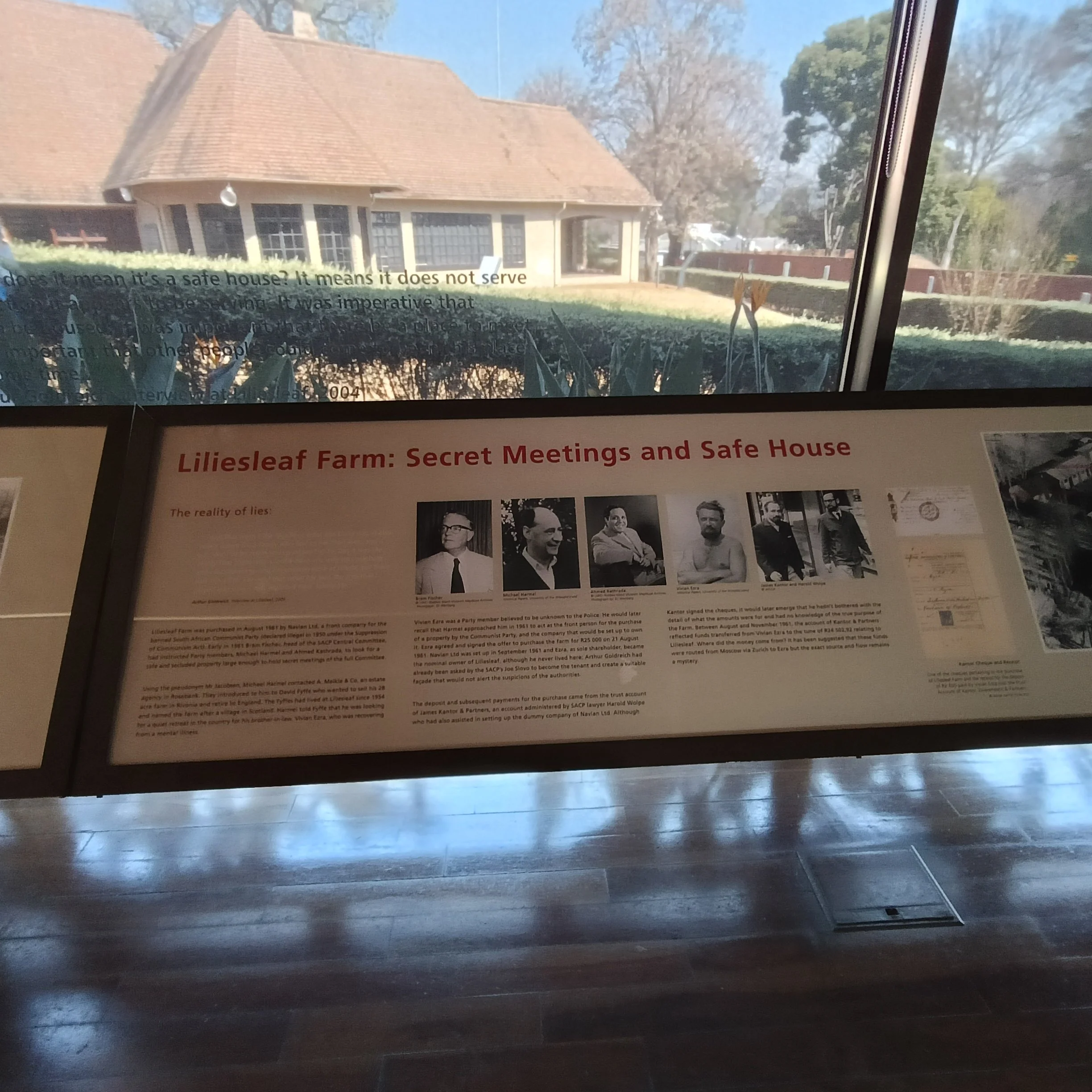
Liliesleaf Farm: Secret Meetings and Safe House, the panel on the covert 1961 purchase.
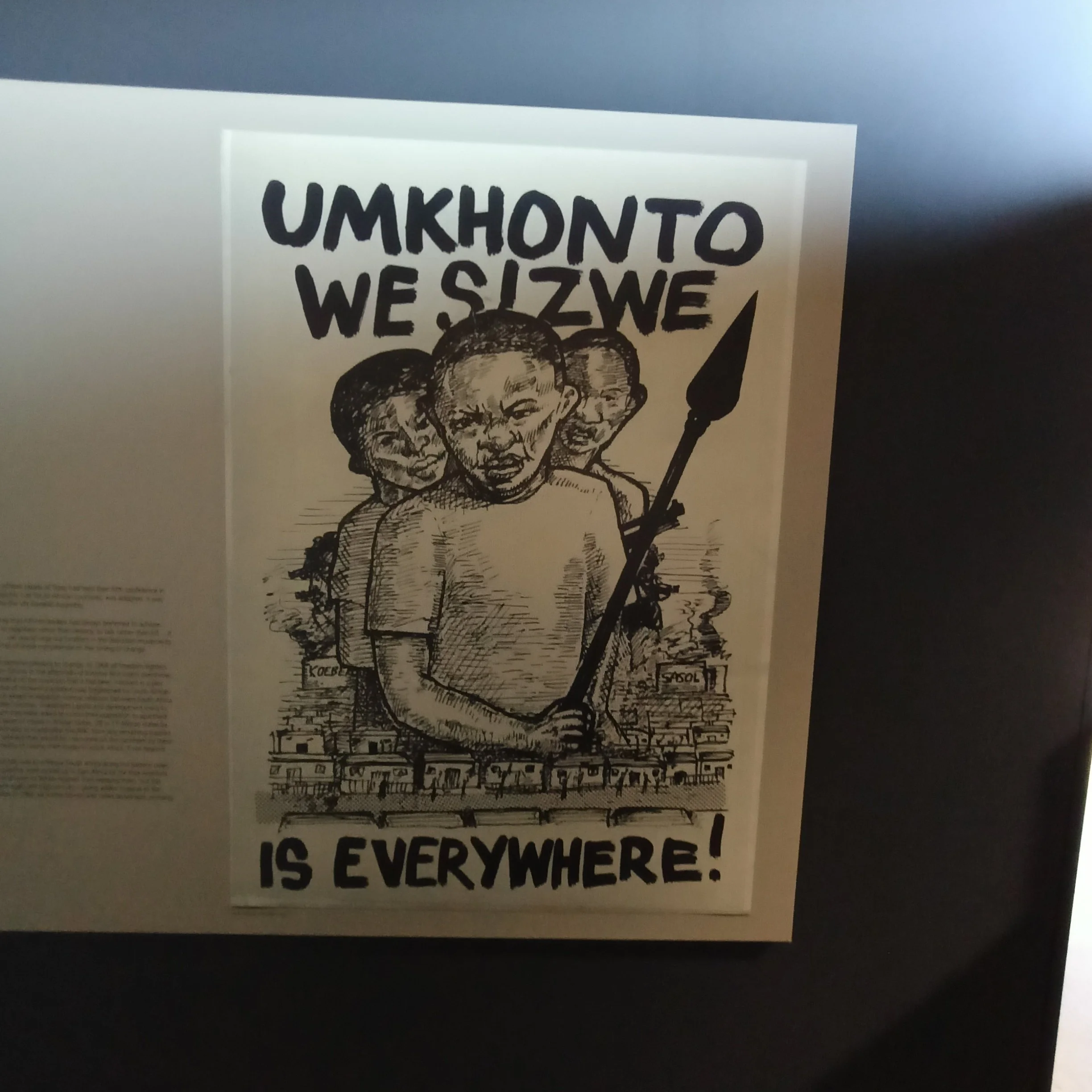
"Umkhonto we Sizwe is Everywhere!", a framed MK poster inside the museum.
Living Two Lives at Once.
What strikes me most, looking back at the photographs I took of Room 1, the Thatched Cottage, and the display called "Recollections of a Cold Winter's Day," is how much of the resistance movement's survival depended on the mundane. A chair. A stove. A washing line. The museum has reconstructed some of these domestic spaces deliberately, because the disguise of Liliesleaf was not a single clever trick but a sustained, exhausting performance of normal life, repeated every day, by people who knew that one slip, one nosy neighbour, one delivery driver who looked a beat too long at the wrong face, could end everything.
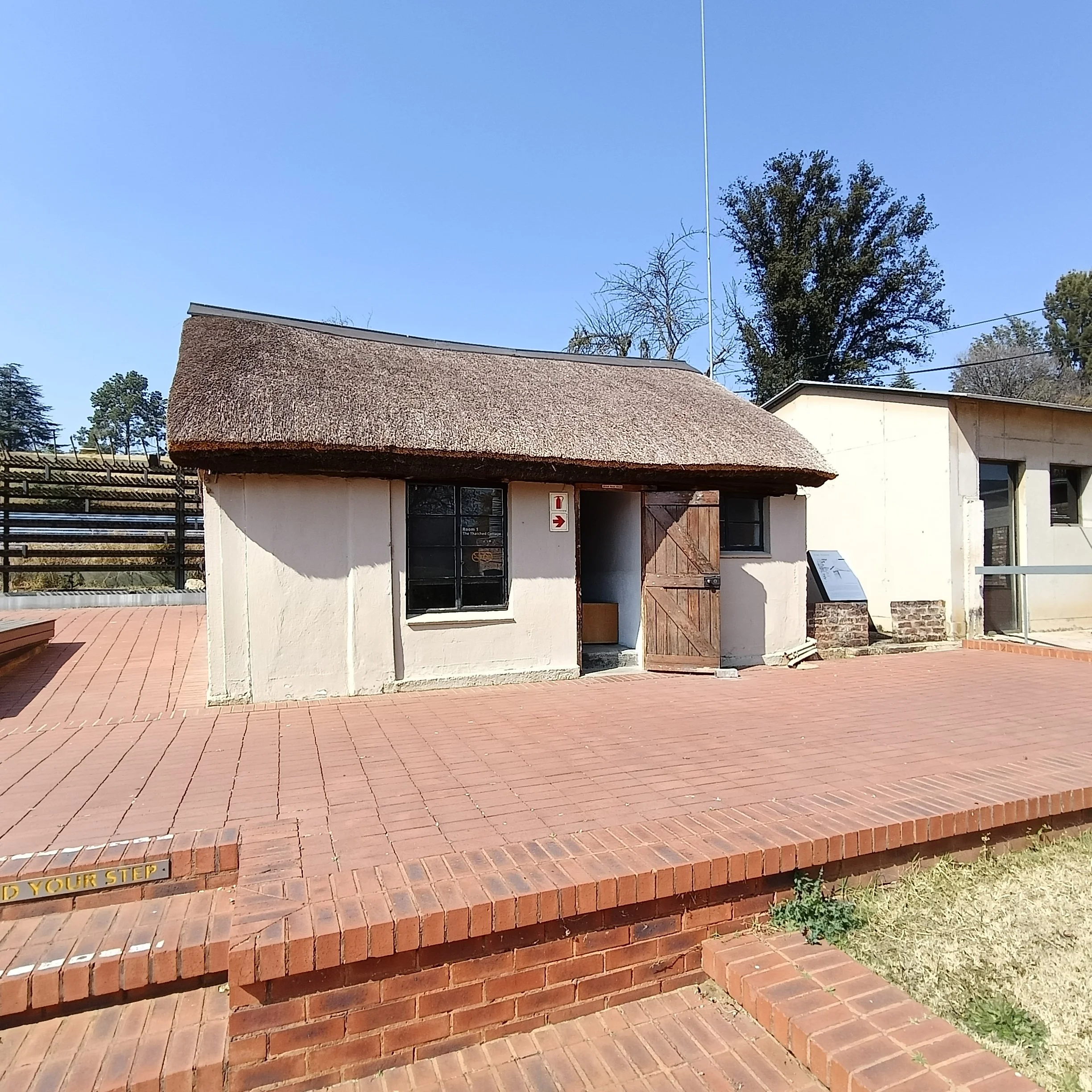
Room 1: The Thatched Cottage.
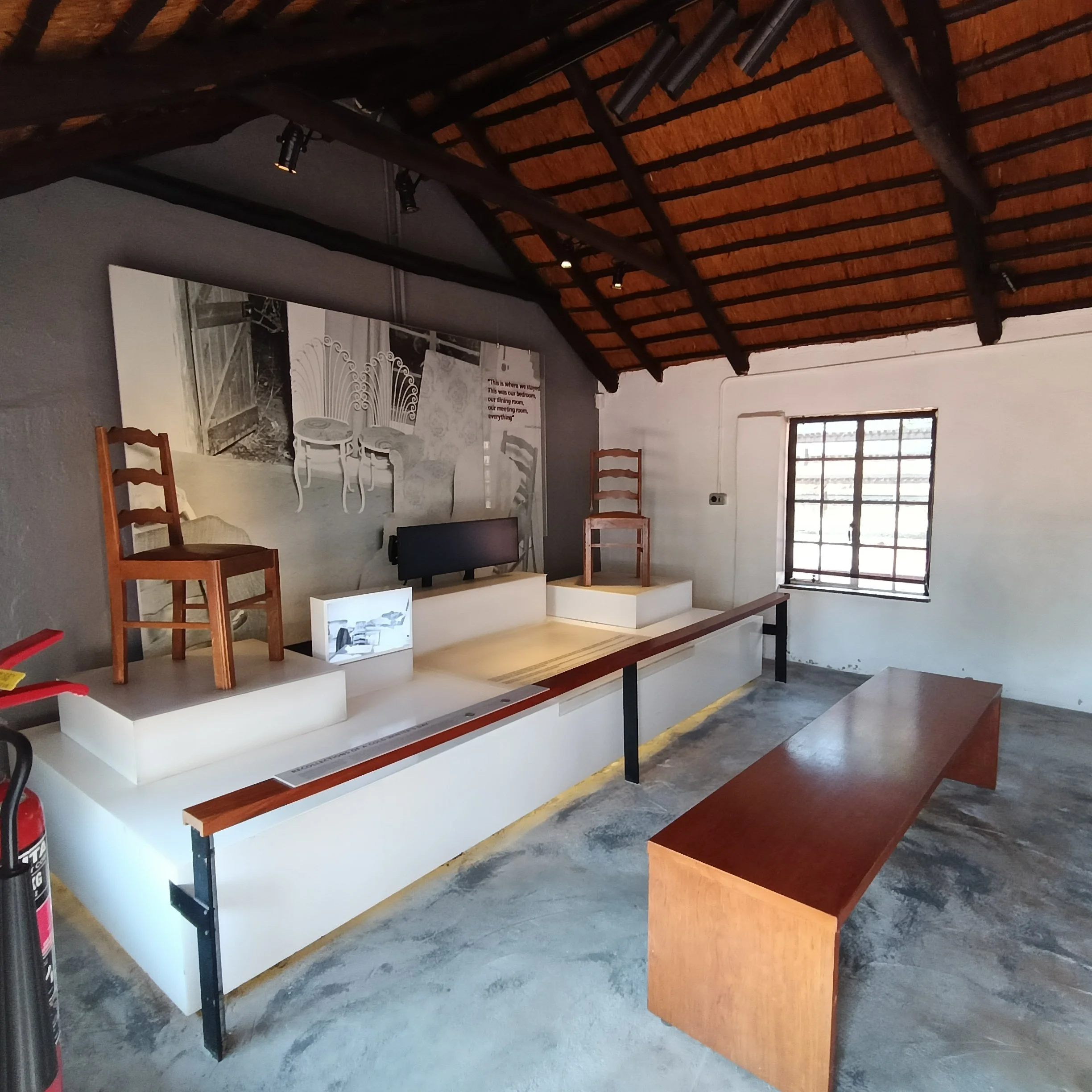
Recollections of a Cold Winter's Day: Two chairs carrying a great deal of memory.
Mandela himself later wrote about this period with a kind of wry tenderness, remembering early mornings spent jogging on the farm to stay fit for a fight he knew was coming, and evenings of intense political discussion disguised as nothing more than men sitting around after a day's work. The "Africa Camping Safaris" exhibit, a liveried vehicle used as cover for movement and smuggling by the underground network, sits in the museum now like a strange, faded prop from a film that turned out to be real. It is one of those objects that makes you laugh, slightly nervously, at the sheer nerve of it, before the weight of what it was actually for catches up with you.
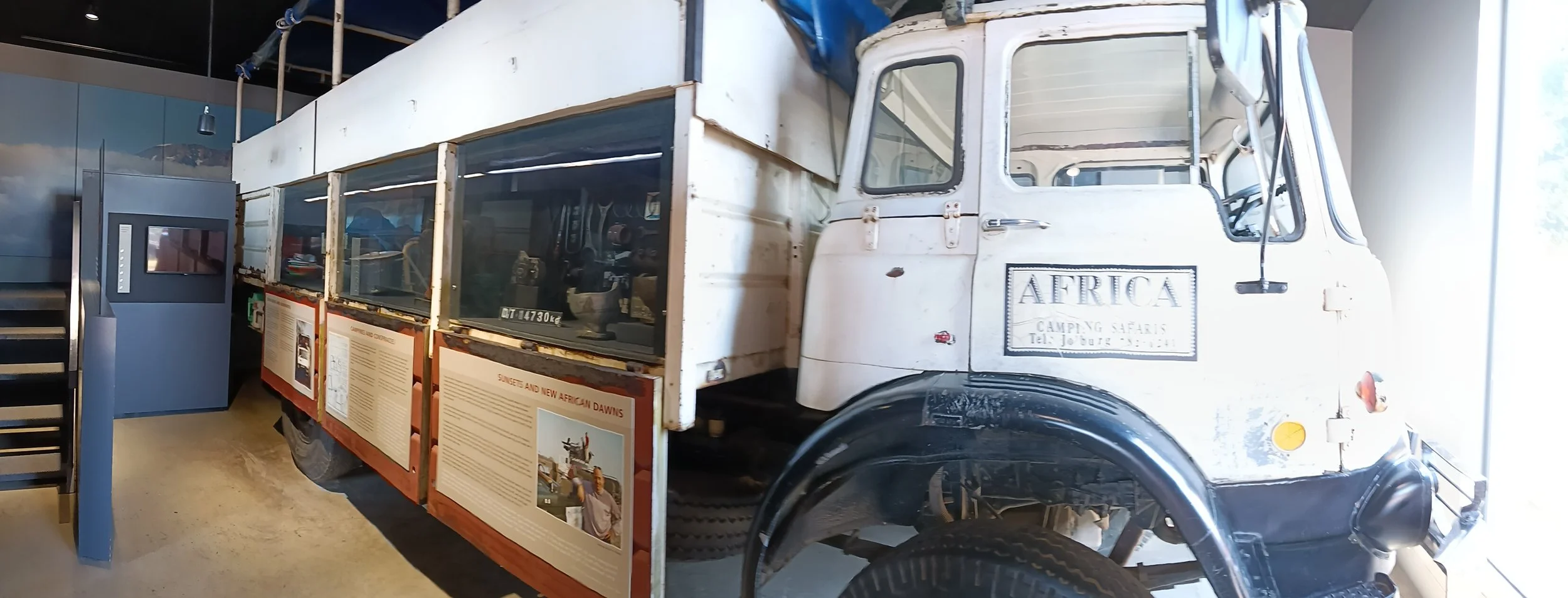
The Africa Camping Safaris vehicle, cover for movement and escape.
The stacked suitcases on display nearby, embedded now with a small video screen playing archive footage, tell a smaller and no less telling story: this was a movement that had to be ready to move at any moment, possessions packed, contingencies rehearsed. Nothing at Liliesleaf was permanent. Everything was staged to be abandoned at short notice. That the raid, when it finally came, still managed to catch so much of the leadership in one place at one time is a measure of how difficult it is to sustain that kind of vigilance indefinitely. Eighteen months is a long time to hold your breath.
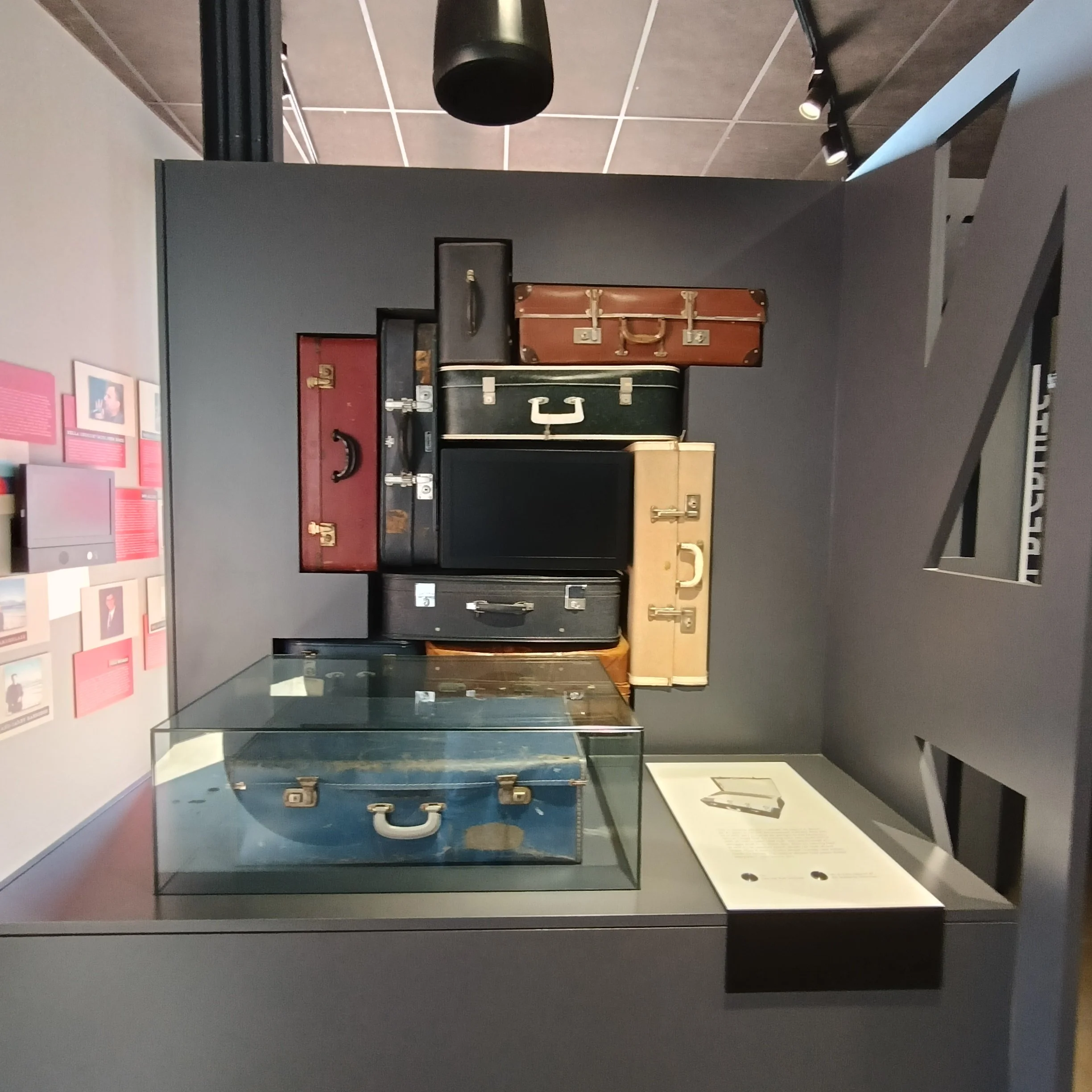
Stacked suitcases, with archive footage playing from a screen set among them.
The Afternoon Everything Ended.
On 11 July 1963, security police, acting on information from an informant inside the network, raided Liliesleaf Farm. One of the darker exhibits inside the house, a deliberately dim interactive board on the informant network within the liberation movement, does not shy away from this part of the story. Betrayal is not a comfortable subject for any museum built to honour the people who were betrayed, but Liliesleaf includes it anyway, and that decision earns it a kind of credibility that a more triumphalist telling would not.
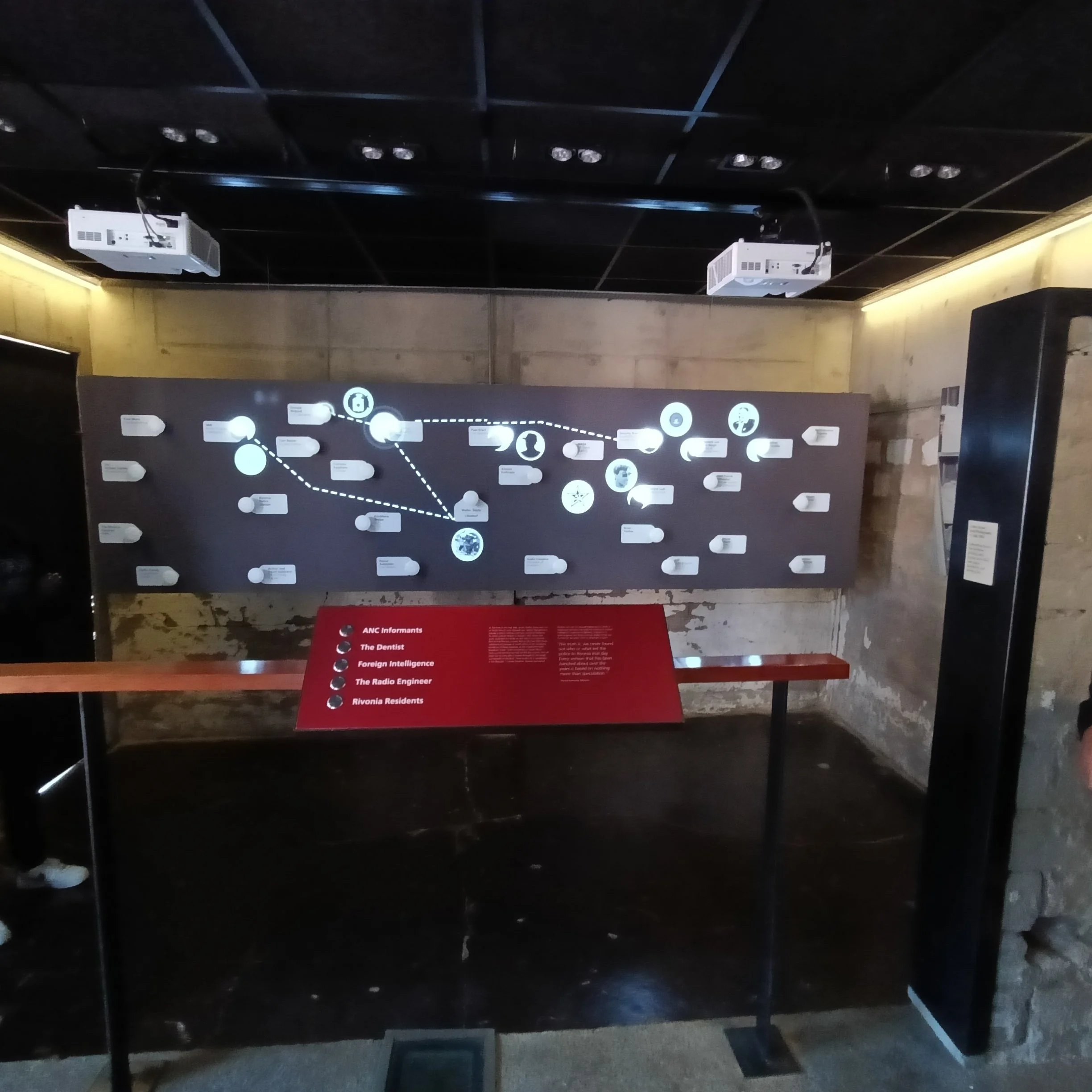
The informant network display, deliberately kept dim.
The raid caught Sisulu, Mbeki, Mhlaba, Kathrada and others in the act of meeting. It also caught the paperwork: notes, plans, and crucially the draft of Operation Mayibuye, a document setting out a strategy for guerrilla warfare against the South African state. Lionel "Rusty" Bernstein, a white communist and architect who had been deeply involved in drafting ANC policy, was arrested there too. The court docket from the National Archives of South Africa, reproduced and displayed inside the museum, records the charge in the flat bureaucratic language the apartheid state used for everything, including its own paranoia: sabotage. The word does a great deal of quiet violence in that document. It criminalised resistance to a system that had already, by any reasonable measure, been inflicting violence on the majority of the country's population for decades.
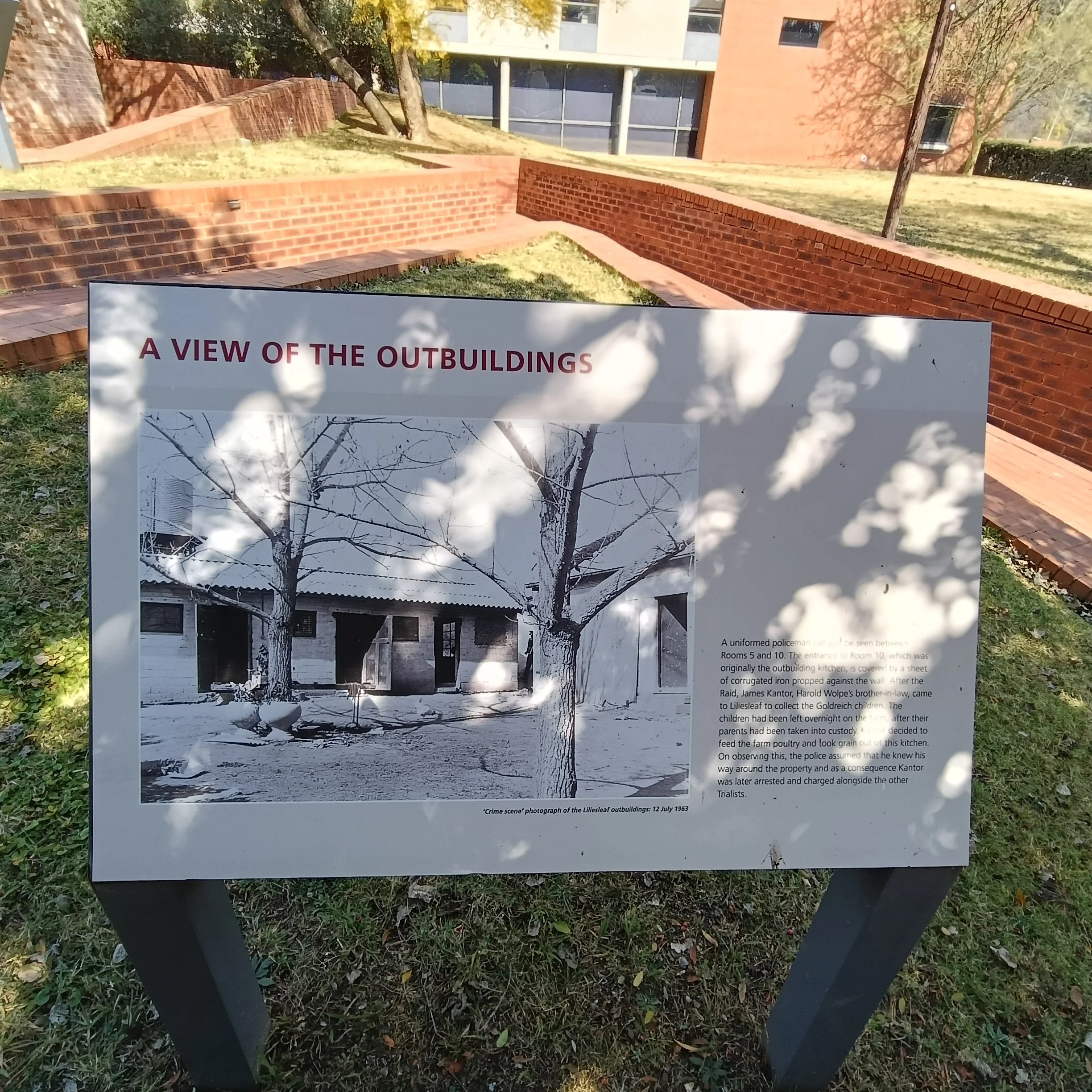
A View of the Outbuildings: the police photograph taken after the 1963 raid.
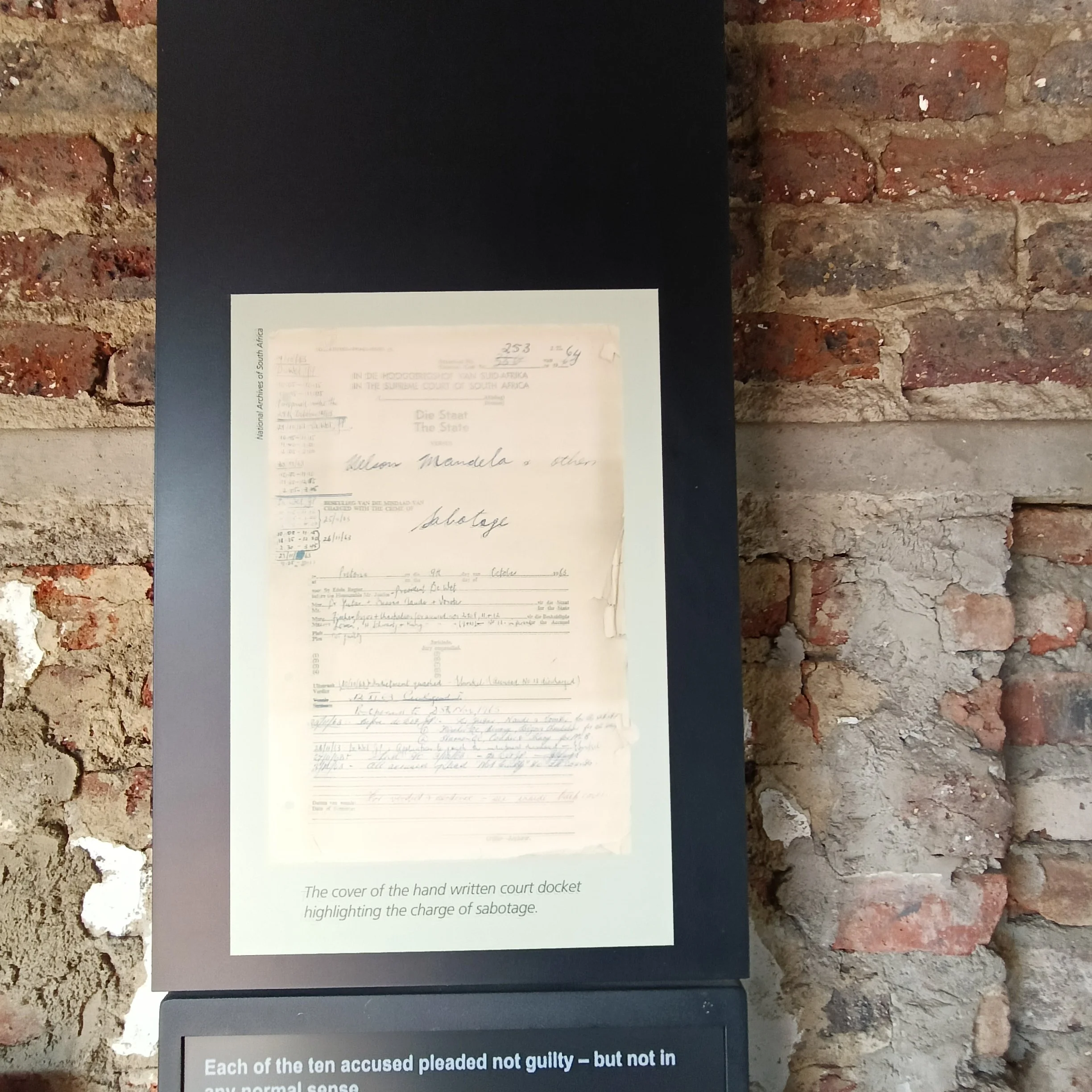
The Rivonia Trial court docket from the National Archives of South Africa, recording the charge of sabotage.
Mandela was not at the farm on the day of the raid. He had been arrested nearly a year earlier, in August 1962, stopped at a roadblock near Howick while travelling under a false name, and had already been serving a five-year sentence for incitement and leaving the country illegally when the Liliesleaf raid took place. But the documents seized at the farm implicated him directly in the planning of armed struggle, and he was brought from prison to stand alongside the others as Accused Number One. The trial that followed, formally the State versus Nelson Mandela and Others but known to history simply as the Rivonia Trial, after the suburb where the farm stood, ran from October 1963 into June 1964.
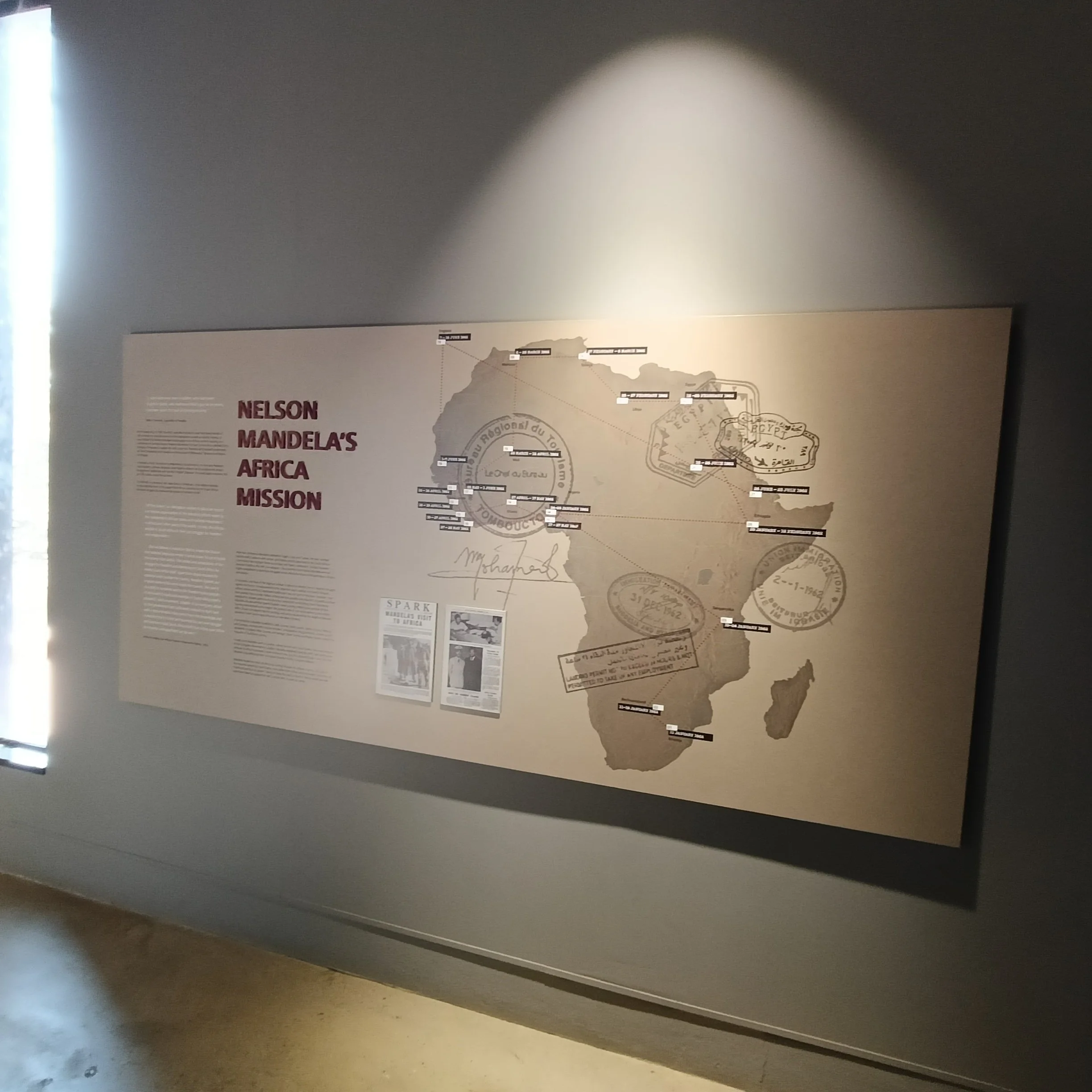
Nelson Mandela's Africa Mission: the 1962 journey that preceded his arrest near Howick.
The "Trial of the Century" panel inside the museum carries a quote from Lionel Bernstein reflecting on just how consequential those months of courtroom argument turned out to be, not only for the accused but for the moral shape of the country's future. It is easy, sixty years on, to treat the Rivonia Trial as a foregone conclusion, a straight line from arrest to Robben Island, but at the time the outcome was genuinely uncertain, and the death penalty was a real possibility that hung over every session.
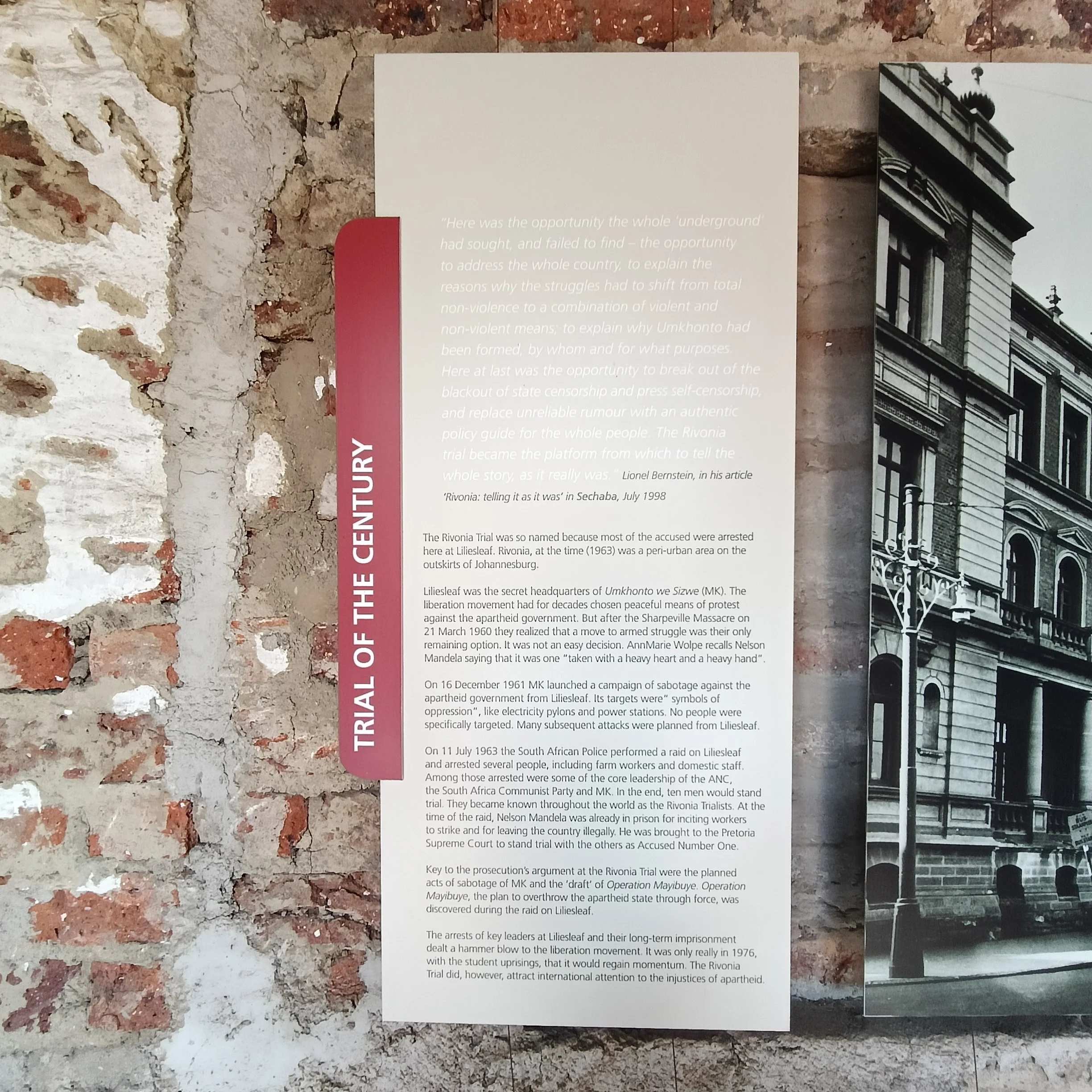
Trial of the Century, with Lionel Bernstein's reflection on the Rivonia Trial.
Mandela's statement from the dock, delivered on 20 April 1964, remains one of the most quoted pieces of political oratory of the twentieth century, closing with the line that he was prepared to die for the ideal of a free and democratic society. He was not called on to make good on that promise in the way the state's prosecutors might have wished. On 12 June 1964, Mandela, Sisulu, Mbeki, Kathrada, Mhlaba, Andrew Mlangeni, Elias Motsoaledi and Denis Goldberg were sentenced to life imprisonment rather than death. Bernstein was acquitted on the sabotage charge but immediately re-arrested under different legislation, and he and his wife Hilda fled the country soon afterwards into decades of exile.
A plaque reproduced on the brick wall of the farmhouse carries Chief Albert Luthuli's response to that sentencing, dated 12 June 1964, and it is worth standing in front of for longer than most visitors do. Luthuli, the ANC's president-general and a Nobel Peace Prize laureate himself, had spent his political life committed to non-violence even as younger colleagues concluded it could no longer work alone. His statement on the Rivonia sentencing is not triumphant. It is grave. It reads like a man taking the full measure of what his country had just done to itself.
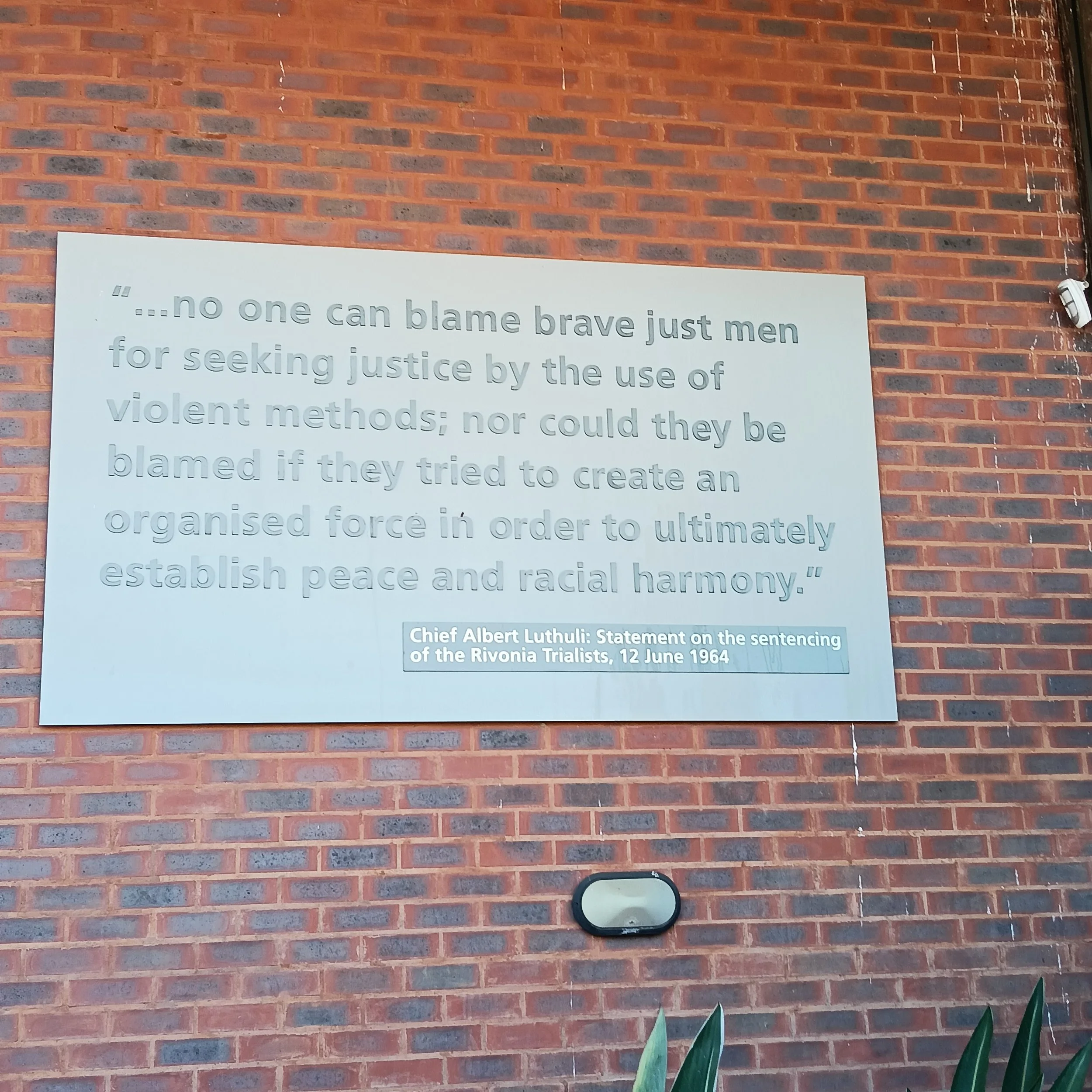
Chief Albert Luthuli's statement on the sentencing of the Rivonia Trialists, 12 June 1964.
Prison, and the Strange Geography of Apartheid Law.
Denis Goldberg's story, told in its own corner of the exhibition, is a useful reminder of how thoroughly apartheid's racial categories reached even into its prisons. Goldberg was the only white member of the MK High Command convicted at Rivonia, and because South African law segregated prisoners by race even at the level of a life sentence for the same crime, he served his time not on Robben Island with his co-accused but in Pretoria Central Prison, separated from the men he had been arrested alongside by a legal system committed to apartheid down to its smallest, cruellest details. He would not be released until 1985, more than two decades after his conviction, having spent all of that time separated from the comrades whose fate had been decided in the same courtroom on the same afternoon.
Andrew Mlangeni, who served twenty-six years for his part in the Rivonia case, gave an interview in 2004 that the museum has reproduced as a plaque near the farmhouse. His reflection on what Liliesleaf meant, delivered four decades after his arrest there and a decade into South African democracy, carries a weight that only survivorship can give a testimony to. He had watched the country he was imprisoned for trying to change actually change, and he had lived long enough to say so on the ground where his own path to Robben Island had begun.
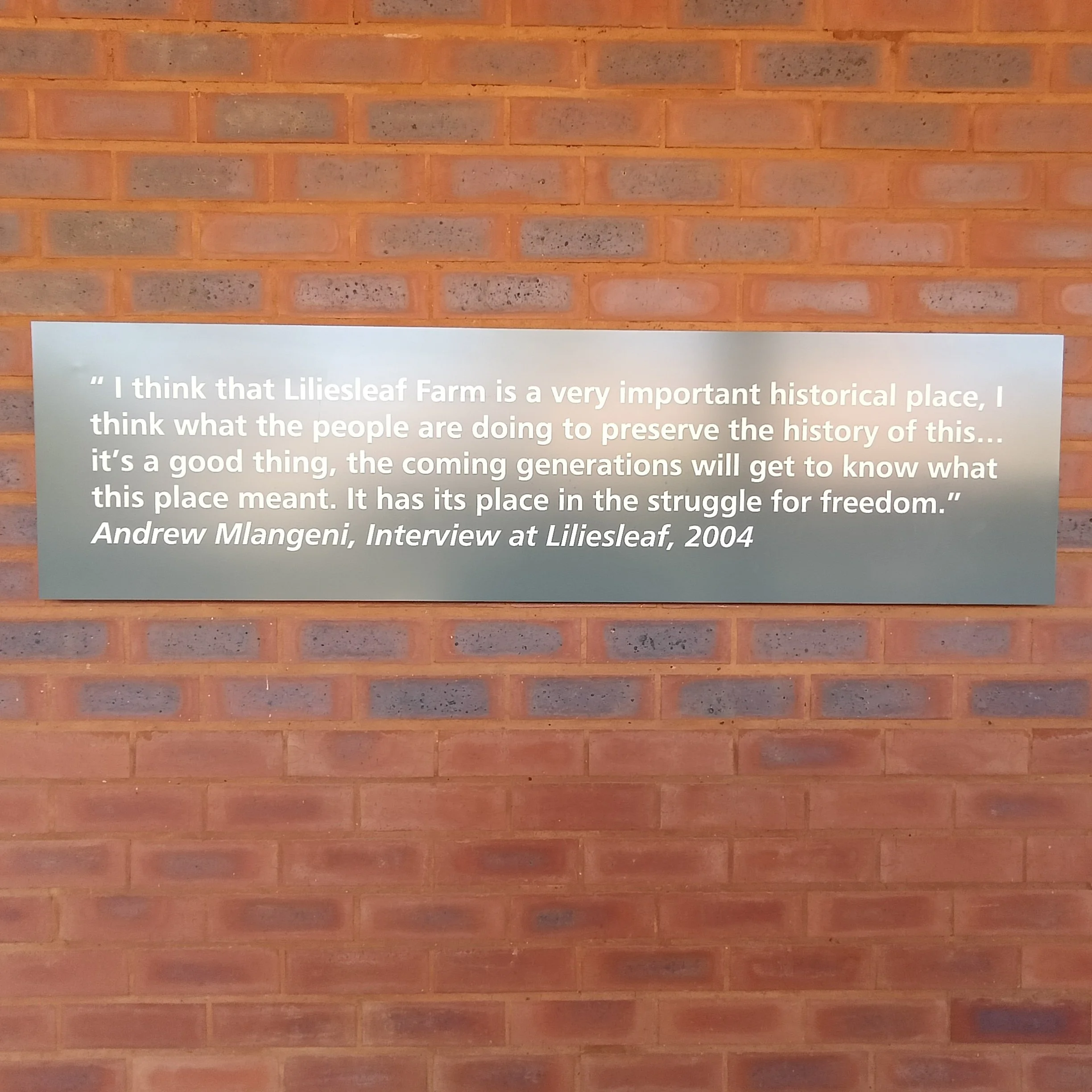
Andrew Mlangeni's 2004 reflection on Liliesleaf, set into the farmhouse wall.
The World Was Watching, and Some of It Helped.
One of the things that surprised me most, walking through Liliesleaf's international solidarity displays, was how much of the ANC's survival in exile depended on a network of foreign support that rarely gets much attention in the standard telling of the story. The panel on the German Democratic Republic's role documents the military training MK cadres received there once the armed struggle moved into exile after Rivonia had effectively decapitated the internal underground leadership. Whatever one makes of the GDR's own record, its support for the ANC's armed wing was concrete and consequential, part of a wider pattern of Eastern Bloc backing for liberation movements across the continent.
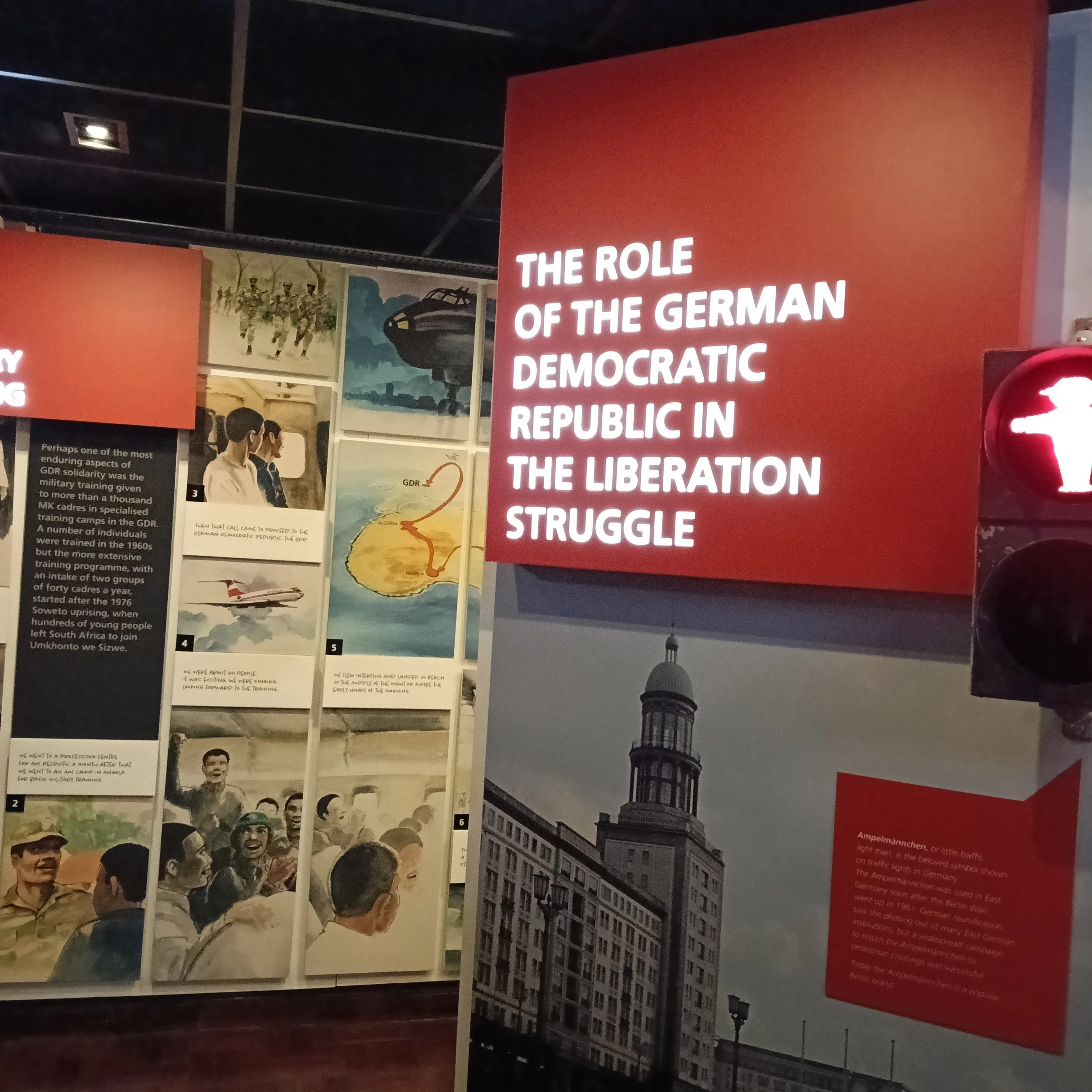
The role of the German Democratic Republic in the liberation struggle.
Sweden's involvement runs even deeper through the exhibition, and it is arguably the most surprising thread in the whole museum for a British or Welsh visitor who has grown up with a fairly narrow, Anglo-centric picture of the anti-apartheid movement. Sweden became, by some measures, the single largest state donor to the ANC during the years of exile, and the personal relationship between Prime Minister Olof Palme and Oliver Tambo, the ANC's president during the long years of banned existence, is given its own dedicated panel. A quote from Thabo Mbeki, later South Africa's president, on the scale of Swedish assistance sits alongside material on Billy Modise and the Swedish government's direct involvement, illustrated with a Swedish-language anti-apartheid boycott poster that must have hung in a shop window or union hall somewhere in Stockholm or Gothenburg in the 1970s or 80s.
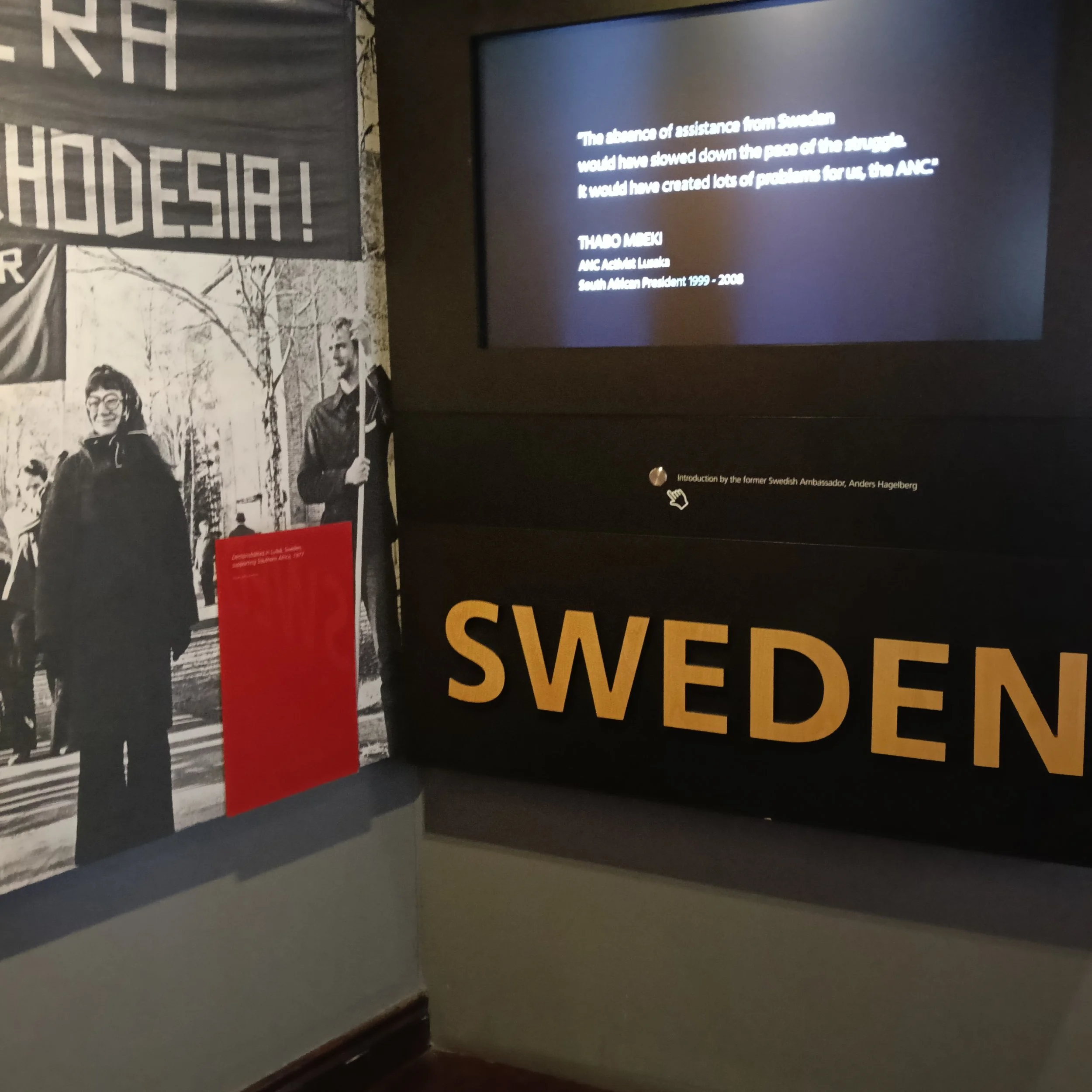
Thabo Mbeki on the scale of Swedish assistance to the ANC.
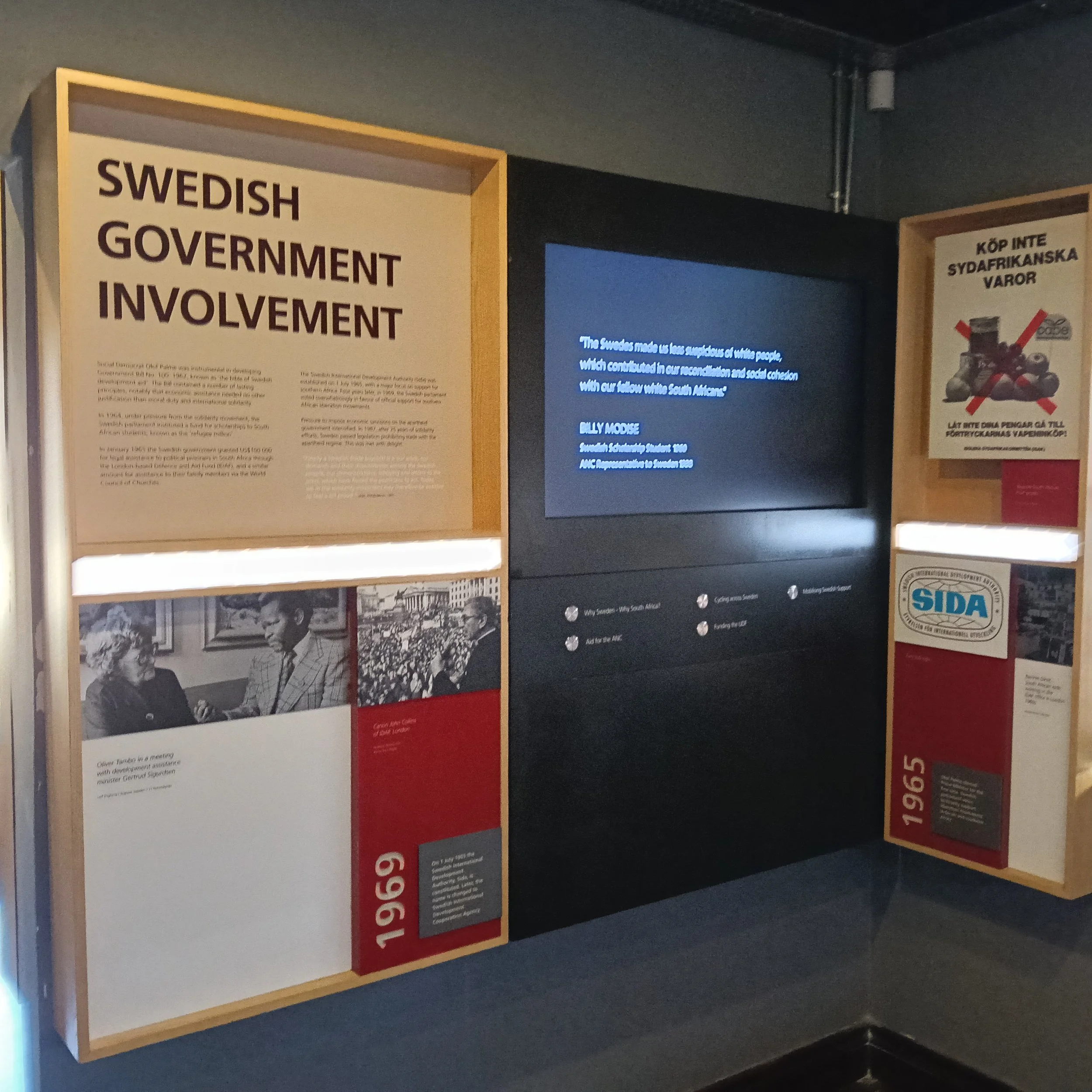
Swedish Government Involvement, with a Swedish-language boycott poster.
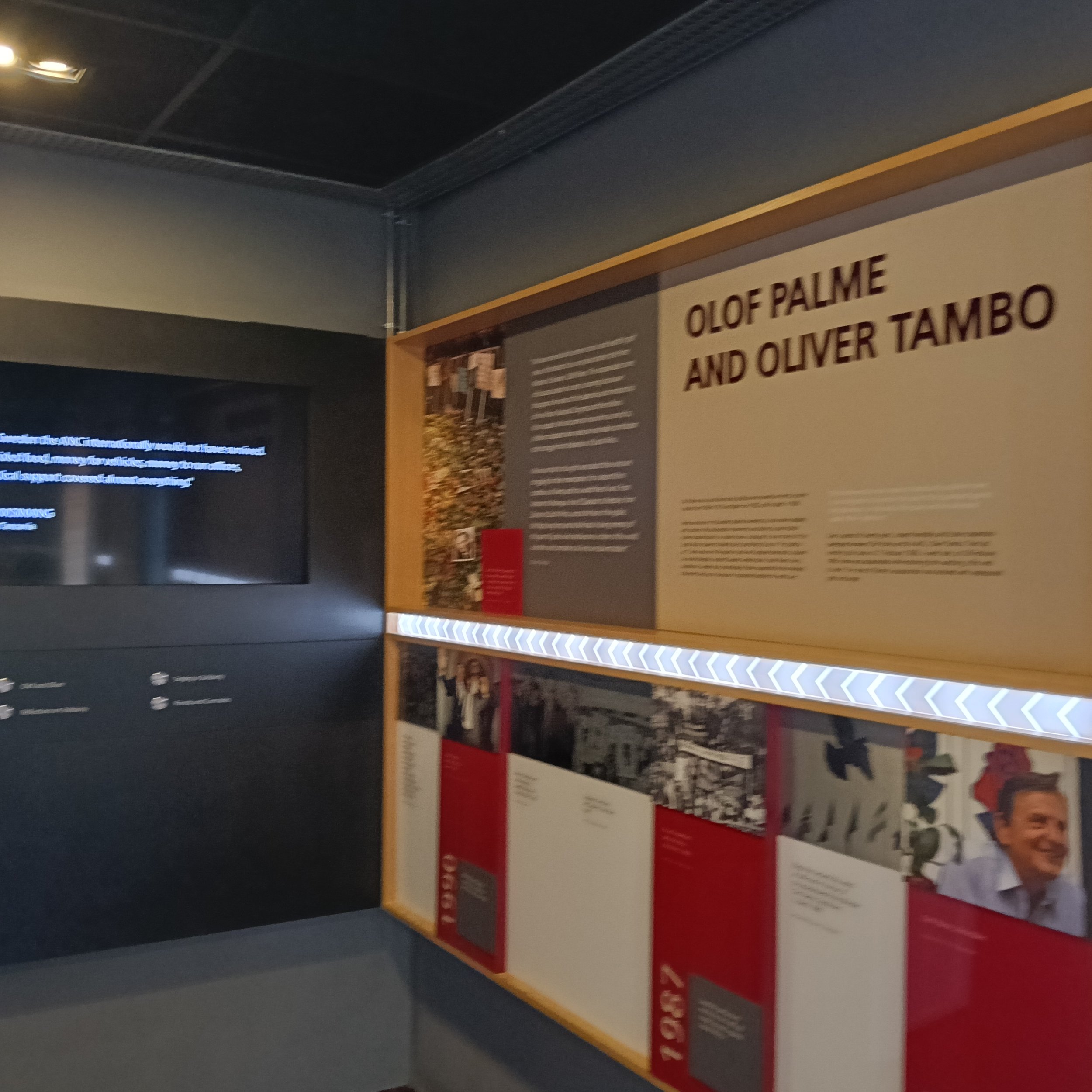
Olof Palme and Oliver Tambo.
The Norwegian material tells a similar story from a slightly different angle: reproduced black-and-white photographs of Norwegian anti-apartheid protesters and demonstrations from the 1960s, standing in solidarity with a struggle thousands of miles away, in a country with no direct stake in South Africa beyond a moral one. A Nobel Peace Prize quote sits alongside the display on activists and apartheid-free zones, and the whole section amounts to a quiet corrective to any assumption that the end of apartheid was primarily a story that unfolded inside South Africa's own borders. It was that, first and foremost. But it was also the product of decades of pressure applied by ordinary people abroad who decided that a boycott, a poster, a protest outside an embassy, was worth the effort even when the outcome felt distant and uncertain.
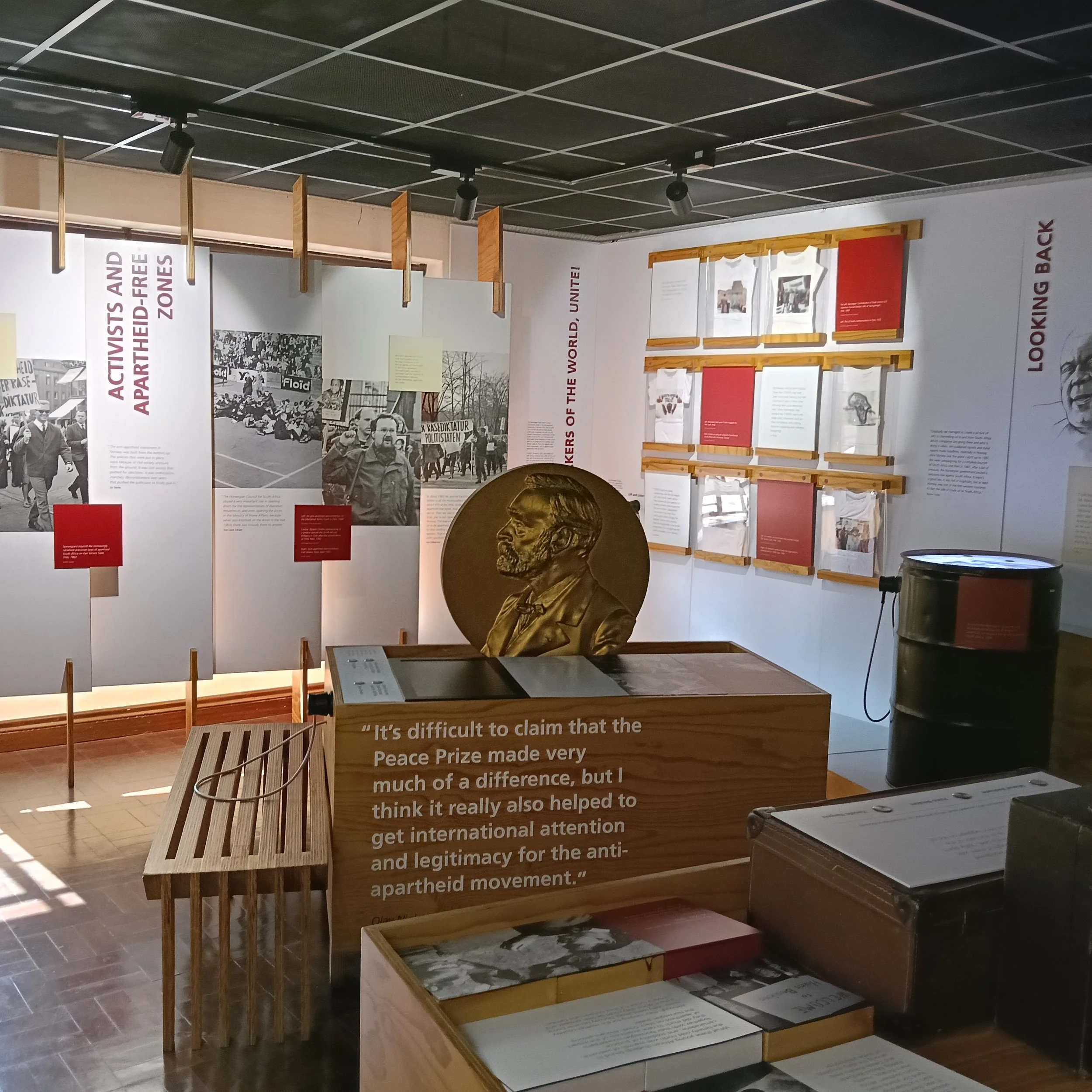
Activists and Apartheid-Free Zones.
A striking black-background poster reading simply "Solidaritat," with a red star and a raised fist, closes this part of the exhibition, and it functions almost as a piece of pure iconography: the visual grammar of international solidarity movements in the second half of the twentieth century, distilled into a single image that could have been produced in a dozen different countries and languages and would have meant the same thing in all of them.
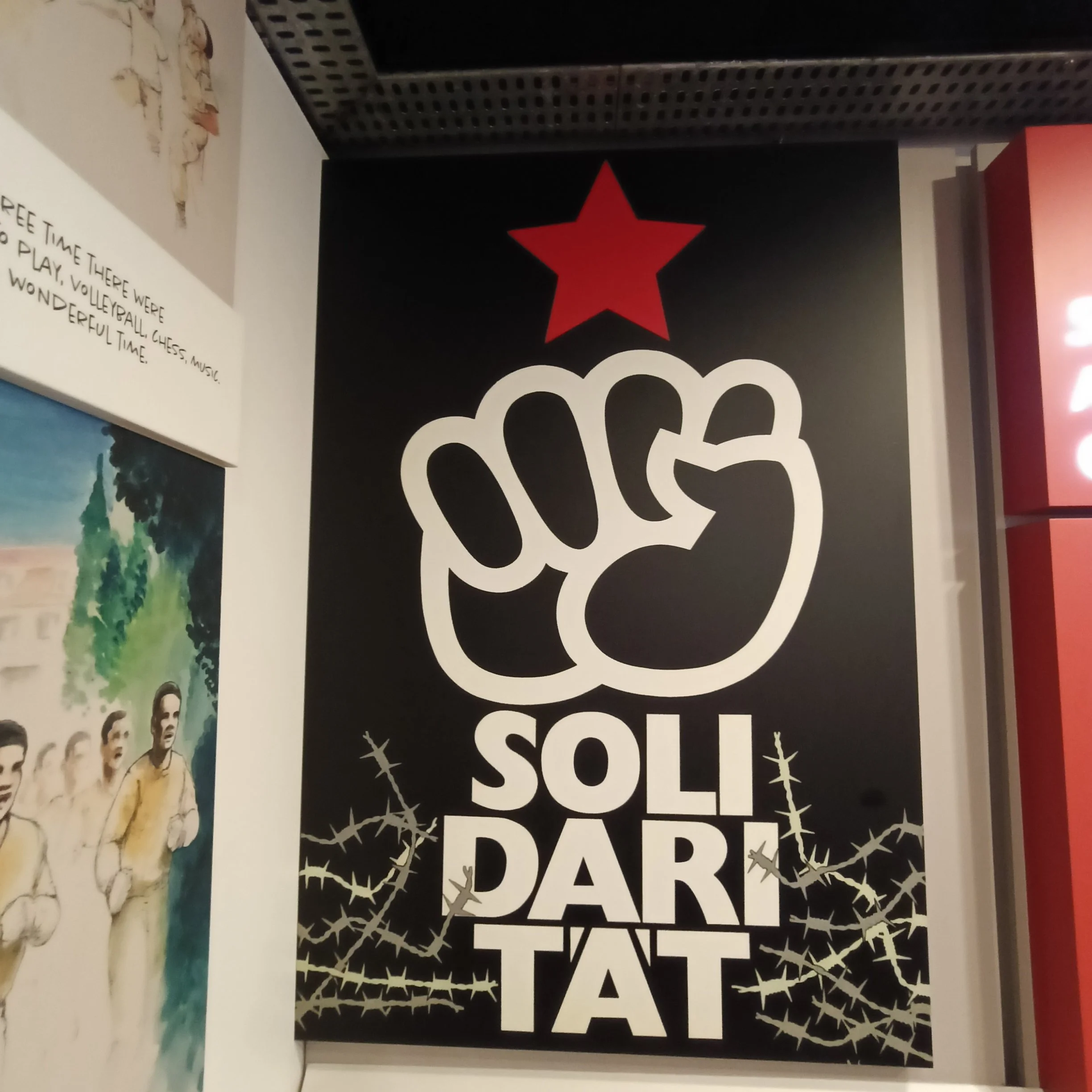
Solidaritat.
What the Farm Looks Like Now.
Walk the grounds today and the buildings themselves do most of the quiet work. Whitewashed walls, thatched roofs, red-brick paths, a clear Highveld sky overhead: from a distance it could still pass for the unremarkable smallholding it was built to resemble. Up close, the low, half-sunk concrete structure beside one of the outbuilding walls, an air-raid or escape shelter dug into the ground with a dark open doorway, is the one part of the site that still reads as overtly clandestine rather than merely historical, a physical reminder that the people who lived and worked here were planning, quite literally, for the ground beneath them to become dangerous.
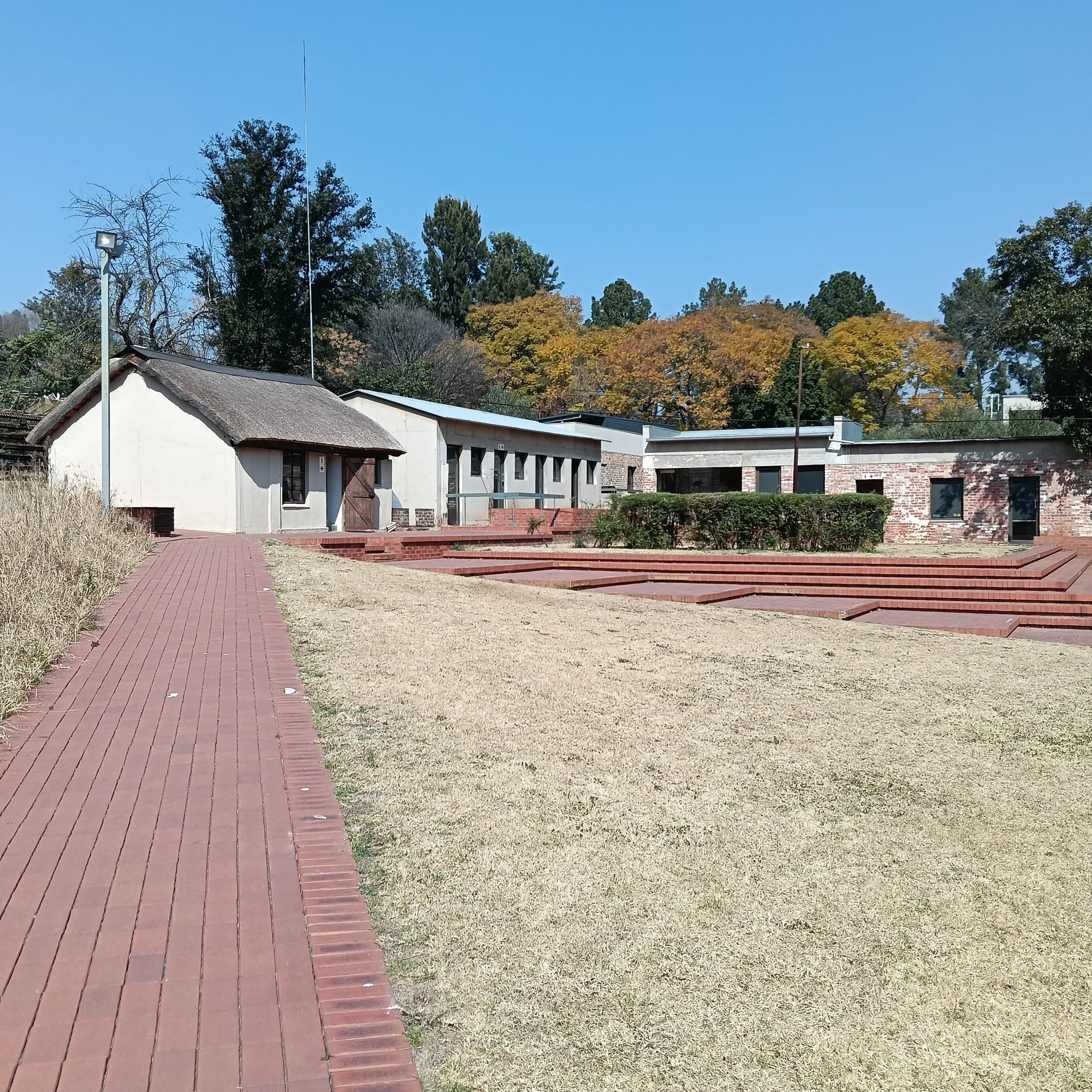
Whitewashed outbuildings and the red-brick path.
Inside one of the smaller buildings, said to be Mandela’s room, a children's tribute wall reading "Thank You Tata for Giving Us Freedom" sits alongside a large reproduced photograph of a young, smiling Nelson Mandela, the kind of image that predates everything the world would later know him for: the trial, the twenty-seven years, the presidency, the global moral authority he carried in old age. It is a good corrective to see him young and unguarded like that, before history had finished deciding what to make of him.
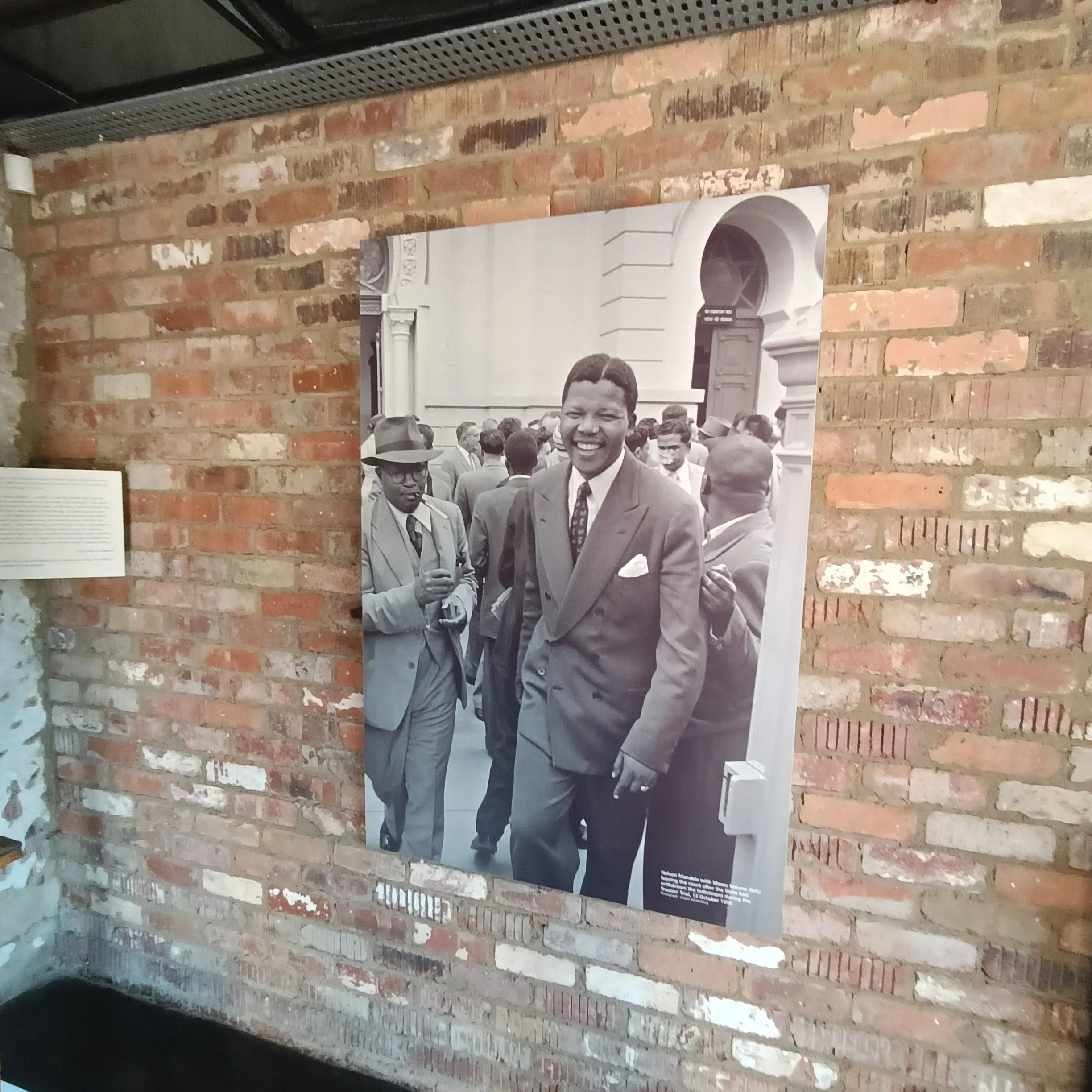
A young Nelson Mandela, before history had finished deciding what to make of him.
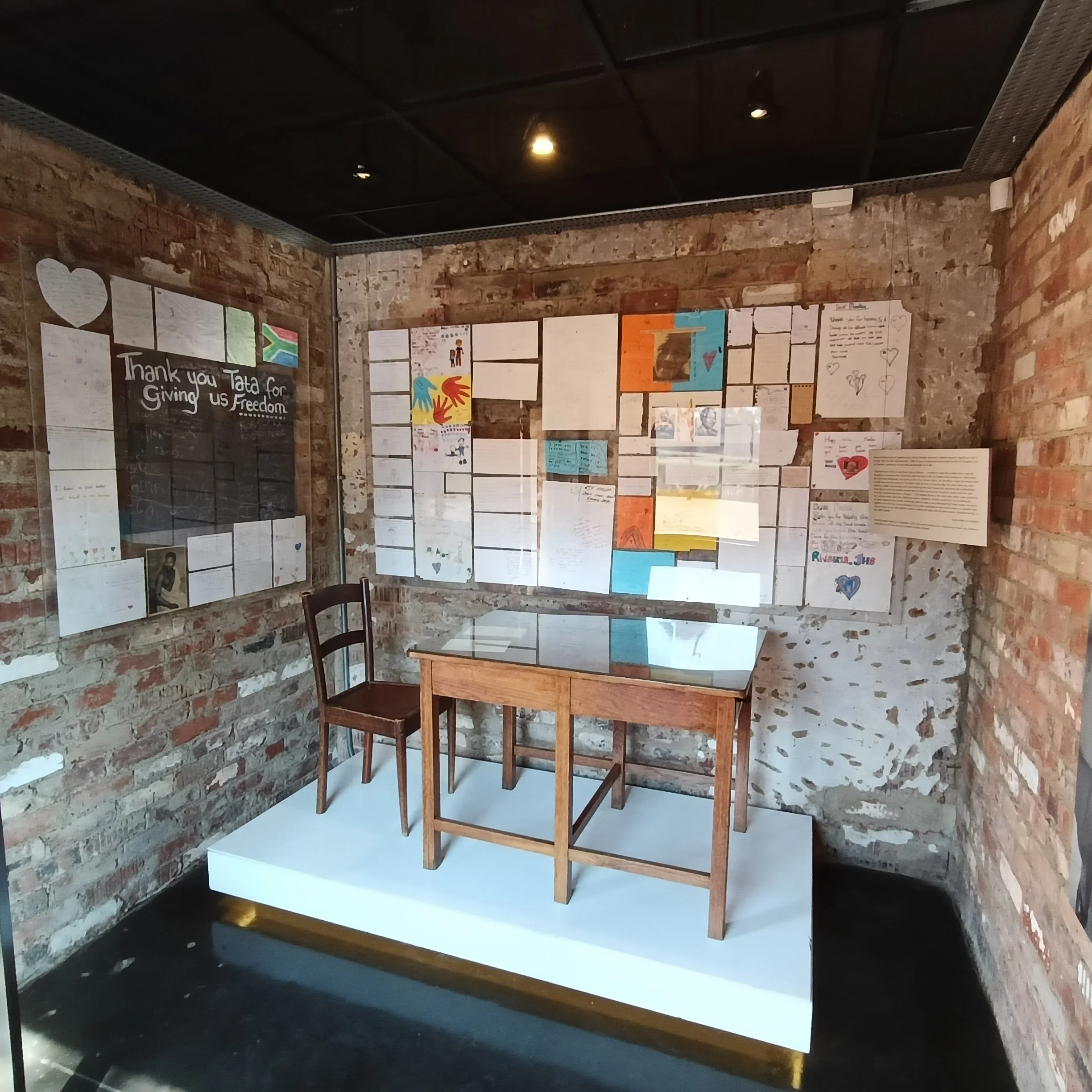
"Thank You Tata for Giving Us Freedom", the children's tribute wall.
The "Path to Liberation" panels near the entrance, the Freedom Charter display against the brick wall, the reproduced Rand Daily Mail front pages from August 1963 covering the so-called pamphlet bombs, small devices used to scatter ANC leaflets in public places as a form of propaganda by disruption: taken together, these displays do something that a lot of heritage sites attempt and few manage as well as Liliesleaf does. They resist the temptation to flatten a complicated, contested, decades-long political struggle into a simple redemption arc ending in 1994. Betrayal, imprisonment, exile, international solidarity, the specific administrative cruelty of racially segregated prison sentencing: all of it is here, sitting uneasily but honestly alongside the parts of the story that are easier to tell.
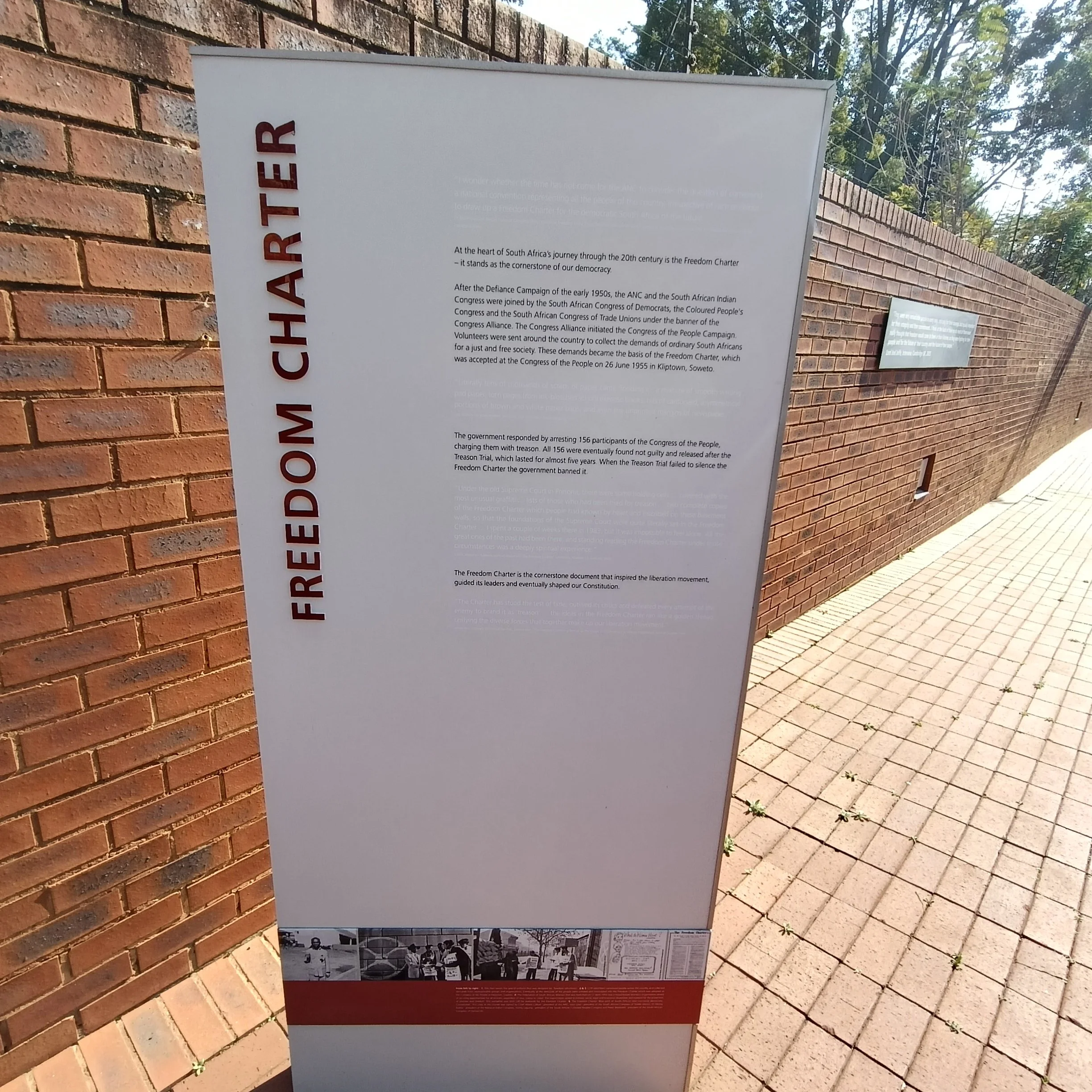
The Freedom Charter display.
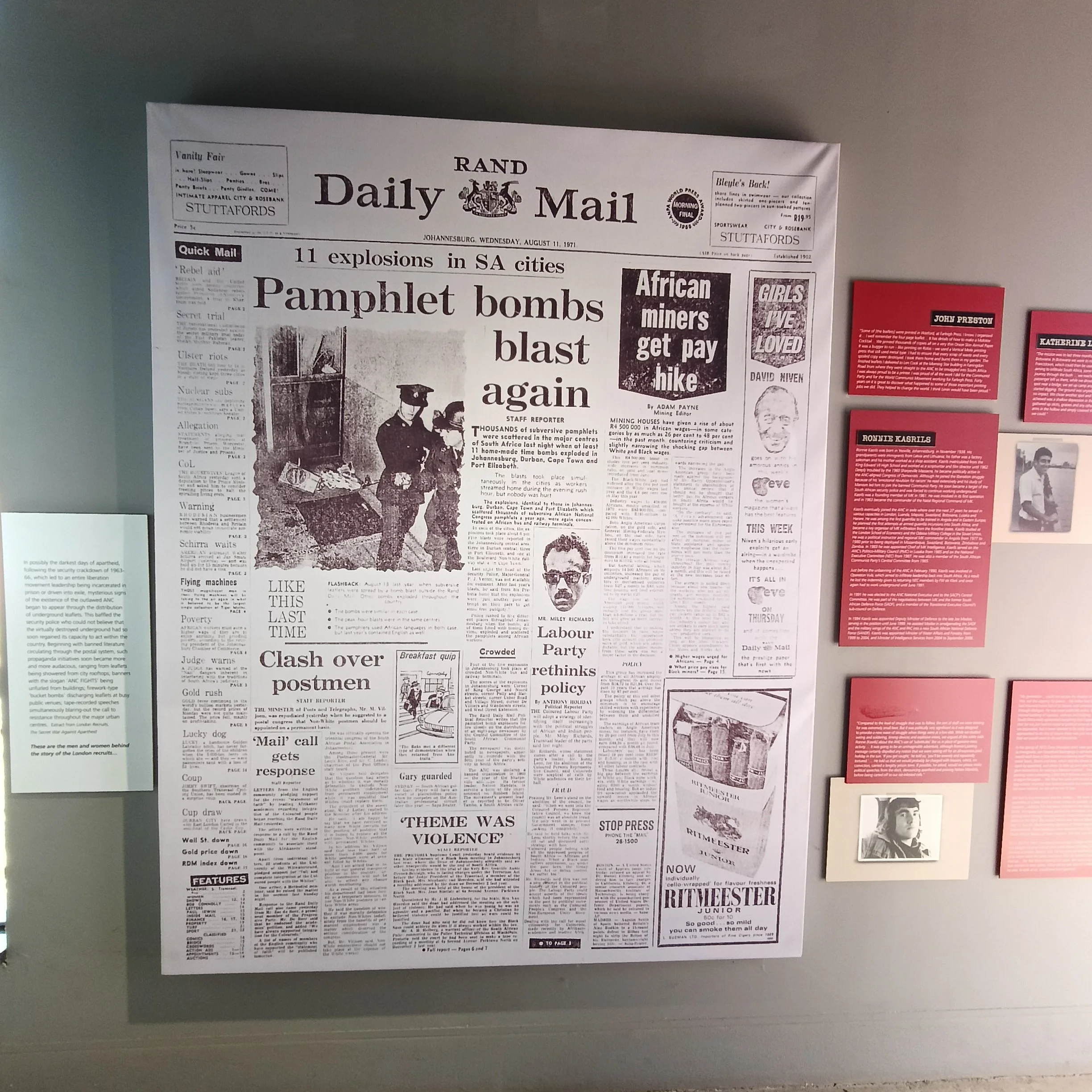
Daily Mail front pages from August 1963, reporting the pamphlet bombs.
A Struggle the Whole World Was Asked to Join.
It would be easy, standing in front of the Swedish and Norwegian panels, to assume that international solidarity was a Scandinavian speciality and leave it there. It was not. The Rivonia Trial landed on front pages across the world in 1964, and it did so at a moment when the apartheid state was still working hard to present itself internationally as a stable, respectable member of the Commonwealth rather than what it actually was. The United Nations General Assembly had already condemned apartheid as a violation of the UN Charter in 1962, and in 1963 the Security Council called for a voluntary arms embargo against South Africa, a full generation before the mandatory embargo that eventually followed in 1977. None of this stopped the trial. None of it stopped the sentences. But it built, slowly and unevenly, the international architecture of pressure that would eventually help force change: sports boycotts, cultural boycotts, disinvestment campaigns, and a growing conviction among ordinary people in dozens of countries that apartheid was not simply an internal South African matter that outsiders had no standing to judge.
Britain's own relationship with this story is more complicated, and more implicated, than the Scandinavian material at Liliesleaf might suggest by contrast. The British government of the early 1960s, like most Western powers during the Cold War, treated South Africa first and foremost as a strategic and economic partner, a source of gold and diamonds and a reliable anti-communist ally at the southern tip of a continent Whitehall was anxious about losing to Soviet influence. It was ordinary British citizens, not the British state, who built the Anti-Apartheid Movement from 1959 onwards, organising the boycotts of South African goods that would eventually become one of the most sustained consumer campaigns in the country's history. Even so, Britain continued selling arms to South Africa for years after the Rivonia Trial, in defiance of the Security Council's request, a fact worth sitting with for a Welsh visitor walking these grounds, because it complicates any comfortable assumption that solidarity was simply something "we" did and apartheid was simply something "they" did.
Wales's own thread into this story is smaller but real. The National Union of Mineworkers in South Wales was among the trade union branches that backed boycotts and disinvestment campaigns through the 1970s and 80s, part of a wider British labour movement tradition of internationalist solidarity that had older roots in Welsh support for the Spanish Republic in the 1930s. It is one of the quieter continuities in Welsh political history, rarely taught alongside the more familiar chapters on the miners' strikes or Chartism, but it belongs in the same lineage: ordinary working communities deciding that a struggle on the other side of the world was, in some meaningful sense, also their struggle.
Building a Museum from What Was Almost Lost.
Liliesleaf did not become a heritage site by any natural or inevitable process. For decades after the 1963 raid the farm passed through private hands, its history known mainly to historians, former MK members, and the dwindling number of people who had actually been there. It took the Liliesleaf Trust, established in the early 2000s with backing that included figures from South Africa's post-apartheid government and business community, to buy the property back, track down surviving participants while they were still alive to be interviewed, and reconstruct the physical spaces from photographs, testimony, and in some cases nothing more than memory and careful archaeological guesswork. The museum opened to the public in 2008, exactly fourteen years into South African democracy, which meant the restoration project ran on a genuine deadline: men in their seventies and eighties who had lived through the raid, the trial, and Robben Island were still alive to be asked what a particular room had actually looked like, but not for very much longer.
That urgency shows in the texture of the exhibition. The "Recollections of a Cold Winter's Day" display, built around a simple chair, only carries the weight it does because someone sat down with a survivor and asked them to describe, in physical detail, what an ordinary evening at the farm had actually felt like, what the light was like, what was on the stove, who was sitting where. Oral history of this kind has a narrow window. Every year the number of people who could still answer that question from direct memory grows smaller, and Liliesleaf's curators clearly understood, in the early 2000s, that they were racing against exactly that clock. Andrew Mlangeni's 2004 interview, reproduced on the plaque near the farmhouse, was recorded during that same window, four years before the museum opened, while the last generation who had actually planned an armed struggle from these outbuildings could still speak for themselves rather than being spoken about.
There is something instructive in this for anyone thinking about heritage preservation more broadly, myself included. A building can survive for a very long time. The specific, textured, first-person memory of what happened inside it cannot. Liliesleaf exists today largely because a small group of people recognised that distinction in time and acted on it, interviewing, photographing, and physically rebuilding a site whose significance would otherwise have faded into an unmarked suburban plot with a slightly unusual sales history.
Robben Island, and the Long Middle of the Story.
It is worth pausing on what "life imprisonment" actually meant for the men convicted at Rivonia, because the phrase can flatten twenty-six years, in Mlangeni's case, or eighteen in Kathrada's, or twenty-seven in Mandela's own, into a single abstract sentence rather than the grinding, day-by-day reality it was. Robben Island in the mid-1960s was a limestone quarry with a prison attached, and hard labour in that quarry, breaking rock in glare bright enough to damage a man's eyesight permanently, was a routine part of the daily regime for most of the political prisoners held there, Mandela included. Visits were restricted to a handful a year, letters were censored and sometimes withheld for months, and the prison's own internal racial hierarchy, a smaller mirror of the apartheid state outside its walls, determined everything from the length of prisoners' trousers to the size of their rations, with black prisoners receiving less of almost everything than their Indian or so-called coloured counterparts under the same roof.
And yet it was also, paradoxically, where a significant part of the intellectual and strategic groundwork for the eventual transition to democracy was laid, in the exercise yards and study circles the prisoners organised among themselves, debating constitutional models and negotiating positions decades before any of it would matter in the outside world. Mandela himself later described the island, only half wryly, as "the university," a place where a genuinely extraordinary concentration of political talent, held together against its will for a very long time, had nothing to do but think, argue, and prepare. It is a strange and uncomfortable thing to say about a prison, but Liliesleaf's own exhibits do not shy away from that complexity either, and I think that refusal to simplify is part of what makes the site worth the detour from central Johannesburg.
Standing There.
I will admit that nothing in any book prepared me for how ordinary the farm buildings themselves would feel, and how much that ordinariness would end up doing the actual emotional work of the visit. You expect gravity from a place like this. You brace for it walking up the drive. What you get instead, at least on a clear winter morning with birdsong overhead and the thatch throwing long shadows across the brick, is something closer to unease: the specific, quietly vertiginous feeling of realising that history very rarely announces itself while it is happening. It arrives disguised as a gardener fetching groceries. It arrives disguised as a family renting a smallholding. It arrives, on an ordinary Thursday afternoon in July, as a knock that the people inside had been half expecting and fully dreading for the better part of two years, and it takes a farm that looked like nothing and turns it, almost overnight, into a courtroom exhibit, a newspaper headline, and eventually, six decades later, a heritage site with a car park and a gift shop and visitors photographing interpretation panels in the winter sun.
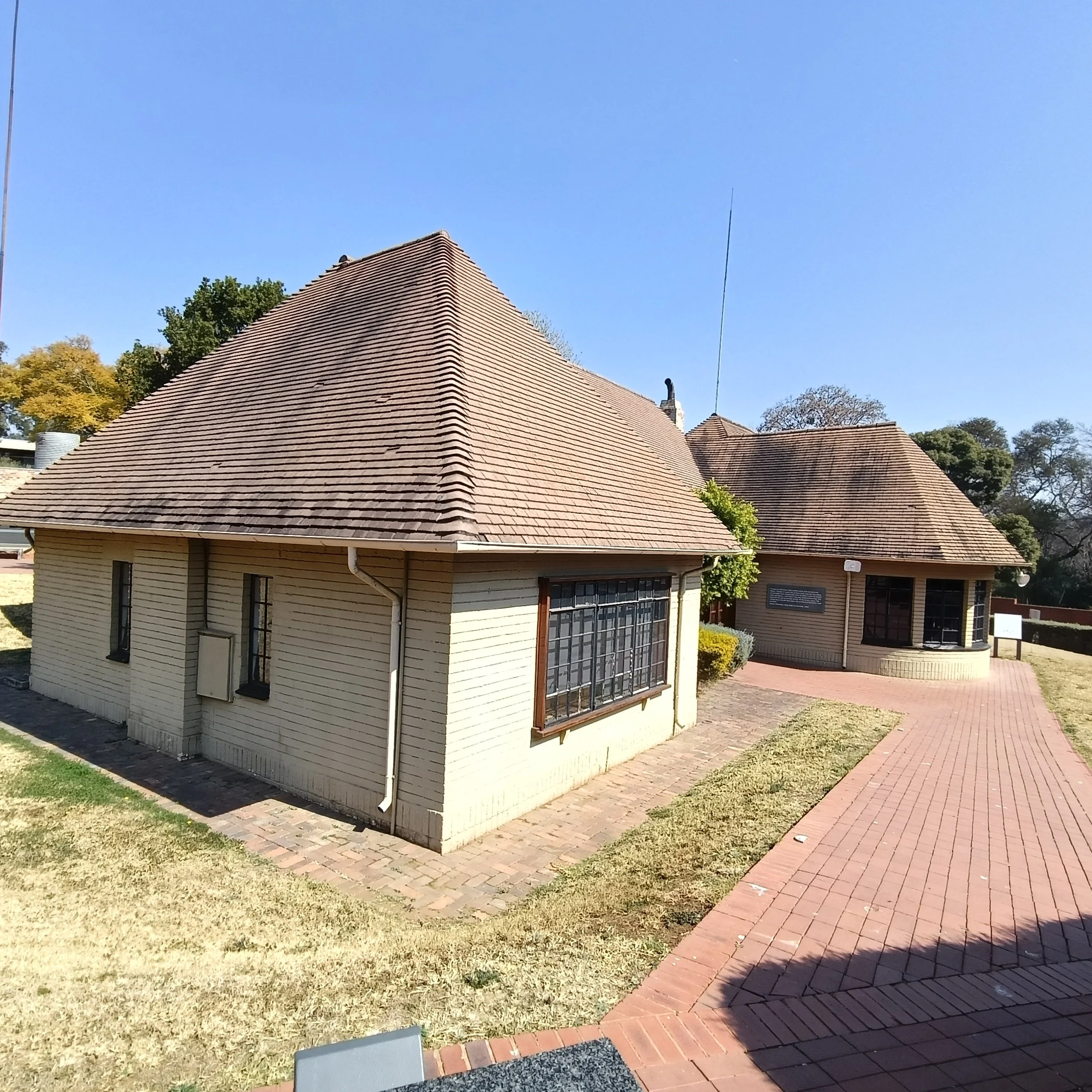
Thatch and radio aerial against a clear winter sky
Echoes and Edges Reflection.
I have visited a lot of sites now where history did something irreversible to the people standing on that exact ground, and Liliesleaf sits among the most quietly powerful of them, precisely because it does not look the part. There is no ruin here, no scorched earth, no obvious violence written into the architecture the way there is at a battlefield or a bombed-out building. What Liliesleaf offers instead is the far stranger experience of standing in a place built to look like nothing was happening, while knowing that everything was.
That, I think, is the real lesson the farm has to teach, and it is one worth carrying with you well beyond the gift shop at the end of the tour. Resistance does not always look dramatic while it is under way. Sometimes it looks like a man in overalls fetching groceries. Sometimes it looks like a rented smallholding with a slightly unusual pattern of visitors. Sometimes it looks, from the outside, like absolutely nothing at all, right up until the afternoon the police finally worked out what they were looking at, and by then the ideas that had been argued out in those outbuildings, about what a free South Africa might actually look like, were already loose in the world and could not be put back.
Liliesleaf Farm did not survive as a secret. It survived as a story, and it is still being told.
There is a habit I have got into, visiting places like this, of asking myself what the equivalent site would look like at home. Wales has its own long, uneven relationship with resistance and remembrance, from the Chartist rising at Newport in 1839 to the miners' halls that once anchored entire valleys and now stand, where they survive at all, as heritage centres or empty shells depending on how kindly the last few decades treated them. We are not always as good as we could be at protecting the ordinary buildings where extraordinary decisions were actually made, preferring instead to commemorate the dramatic set-piece, the battle, the march, the single iconic image, over the quiet farmhouse or committee room where the real planning happened. Liliesleaf is a useful corrective to that instinct, precisely because it insists on the unglamorous mechanics of resistance: the meetings, the disguises, the paperwork, the waiting. Revolutions are planned in rooms with kettles in them far more often than they are planned on battlefields, and a heritage sector that only preserves the battlefields is only telling half the story.
