

Bahrain’s burial mounds stand close to modern neighbourhoods. Pale rises of stone and earth stretch across ground where shrubs grow between the graves and houses line the horizon. The ancient cemeteries remain part of an inhabited island, not a landscape set apart from daily life.
The repetition of the mounds gives the ground a deliberate shape, although the intentions behind it are now difficult to recover in detail. Someone chose a place. Stone was gathered and a chamber built. A body was laid to rest. These acts, repeated across generations, left one of the most extensive surviving records of Early Dilmun.
Failaka opens a view of the Gulf as a connected historical landscape. In Bahrain, the burial grounds bring that wider story down to the scale of individual lives. To understand them, we need the island’s settlements and harbours beside them. The people buried here belonged to a working, trading society, with homes to maintain and relationships extending beyond the shore.
The Dilmun Burial Mounds: a UNESCO World Heritage Site.
Inscribed on UNESCO’s World Heritage List in 2019, the Dilmun Burial Mounds property comprises 21 component sites in western Bahrain. UNESCO records approximately 11,774 mounds within it and gives a broad construction range of about 2200–1750 BCE. That figure describes the protected property rather than every ancient burial on the island. Even within this defined selection, the number is difficult to hold in mind.
The designation recognises both the evidence these graves preserve for Early Dilmun society and their distinctive architecture. Six components are mound fields; the other fifteen contain seventeen royal monuments. Their value lies in the relationship between many ordinary burials and the exceptional tombs, not simply in the most imposing structures.
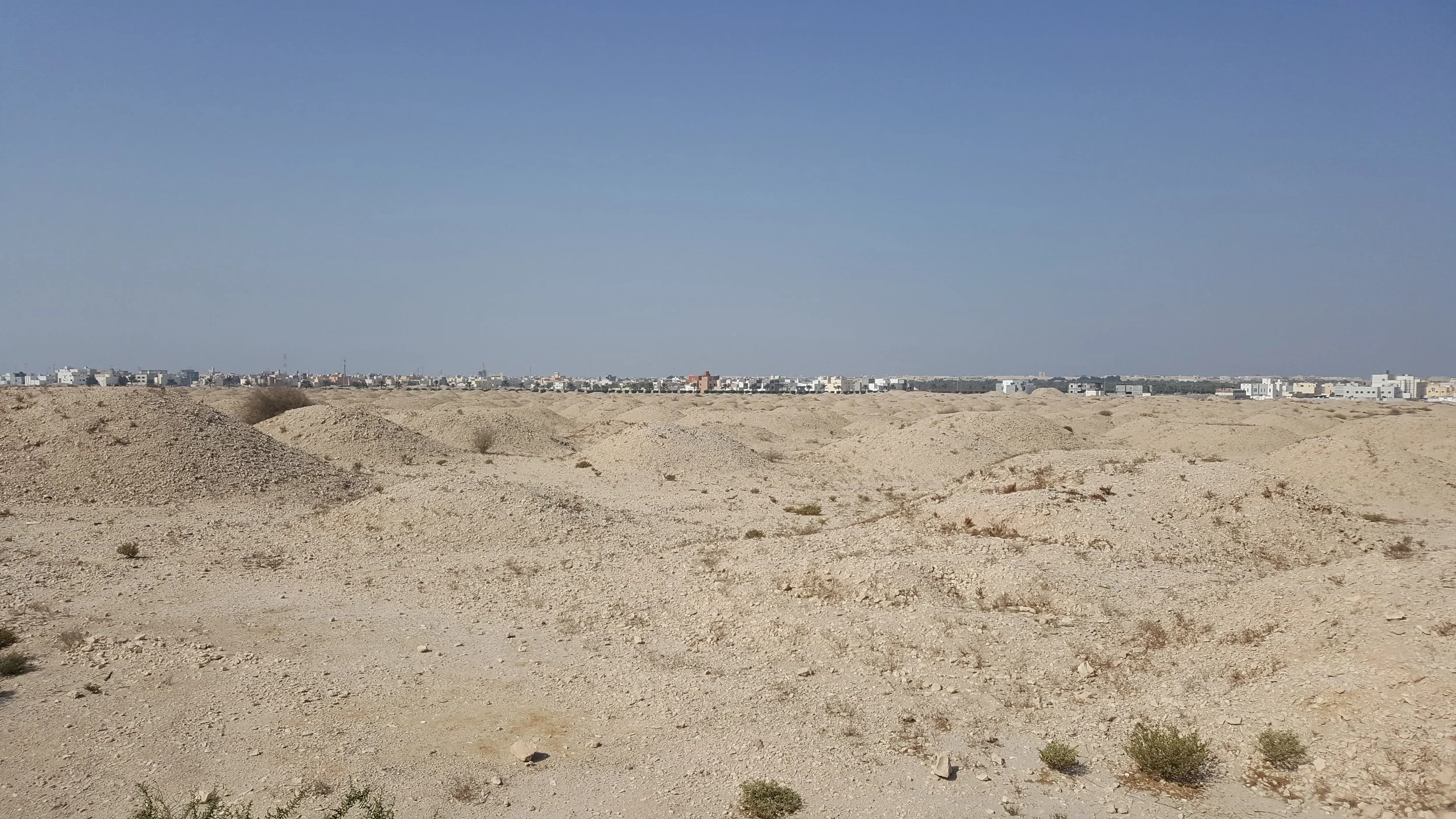
Burial mounds beside the modern skyline in Bahrain.
At first, a mound may appear to be a simple heap. Archaeology reveals a more deliberate structure. Many of these monuments began as low cylindrical towers. Their softened outlines today conceal the architecture that once gave them a sharper presence above the ground.
The Late Type tombs, generally dated to about 2050–1750 BCE, often contained a dry-stone chamber roofed with capstones. A surrounding ring wall defined the monument. Chambers could have L-, T- or H-shaped plans, and alcoves were a distinctive feature. Some examples had more complicated arrangements. The interior required decisions about space and the weight of stone above it.
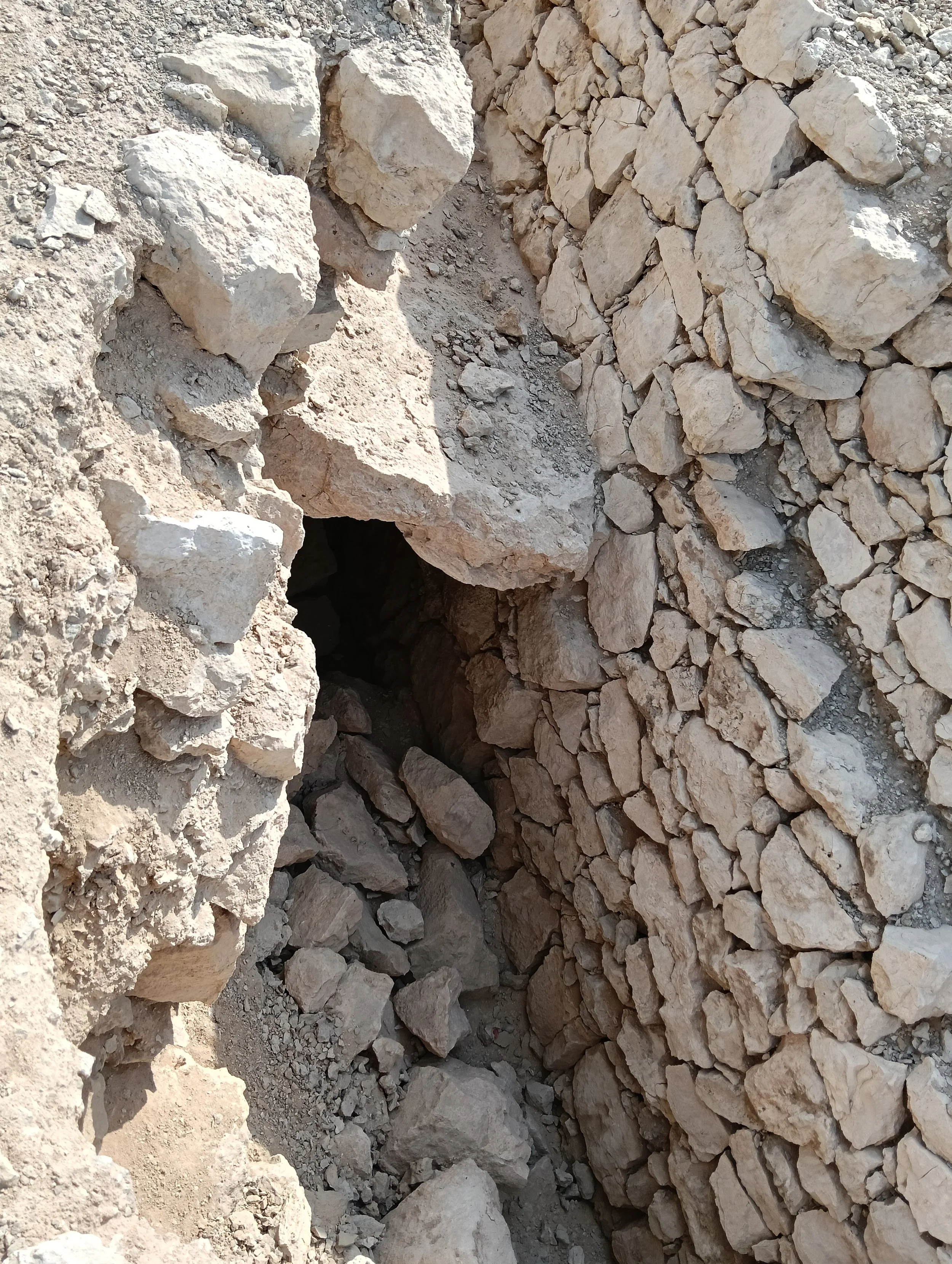
A stone-lined opening within the burial mound.
Building such a tomb took labour. Materials had to be selected, moved and fitted. Even without knowing who carried out each task, the finished structure gives some measure of what a community was prepared to undertake for its dead. The work had a physical cost, borne by people who still needed to feed themselves and continue their daily lives.
The position of the cemeteries also belongs to the living economy. The ICOMOS assessment links their distribution to Bahrain’s geology and the value of its limited cultivable land. Burial grounds occupied less fertile terrain, leaving productive ground available for other uses. The dead had a place within an inhabited island whose land supported competing needs.

The exposed stone courses and cut face of a mound.
Differences among the mounds.
The cemeteries preserve differences as well as repetition. Some monuments are comparatively modest. Others demanded considerably more space and construction. The larger examples traditionally described as chieftain and royal mounds make those distinctions particularly visible.
At A’ali, elaborate royal tombs extend the story beyond architectural inference. Stone-vessel fragments recovered by Bahraini archaeologists carried cuneiform inscriptions naming Yagli-El. One identified him as the son of Rīmum. Here, among thousands of largely anonymous burials, a relationship between two named people emerges.
The evidence also has different degrees of certainty. Yagli-El’s name comes from the inscribed material associated with his tomb. The attribution of a preceding royal tomb to his father draws on the sequence and analysis of the monuments. The Bahrain Authority for Culture and Antiquities (BACA) places the two tombs around 1715 and 1700 BCE, later than the endpoint in UNESCO’s general property description. Those specific dates remind us that a convenient range on a heritage page cannot contain every detail of an evolving chronology.
A named king can easily draw attention away from the surrounding graves. Yet the wider landscape matters because it contains evidence for people of different ages and positions in society. Differences in tomb scale suggest unequal access to resources. At the same time, the extent of the burial tradition shows how broadly the making of monuments entered communal life.
A small tomb still required someone’s work. Its occupant’s name may never be recovered, but the effort invested in the burial survives as evidence. The absence of an inscription should not make that person disappear from the history we choose to tell.
Objects left with the dead.
The objects placed with the dead connect the burial fields with the wider world of the living. Pottery, copper and bronze objects, beads and carved stone vessels have been recovered from the tombs. Some pottery was locally made; other pieces arrived through connections beyond Bahrain. Objects moved between places during life and could acquire a place among the dead.
A vessel in a burial has more than one history. Its material and manufacture concern the people who made it. Its movement concerns exchange. Its final placement concerns those involved in the burial. These histories overlap, even when excavation can recover only fragments of them.
Disturbance complicates the picture. Many tombs were looted in antiquity, removing objects and altering their contents. What survives is therefore an incomplete record of the original burial. An apparently sparse assemblage cannot automatically be read as evidence that little was placed there.
Dilmun also had a life in literature. The Sumerian composition Enki and Ninhursanga presents an idealised land and connects its transformation with fresh water, cultivation and a trading quay. The poem gives another kind of presence to a place encountered through the ground. Its imagined landscape belongs alongside the archaeological one, with the distinction between them kept clear.
Keeping the burial landscape.
The mounds also belong to Bahrain’s present. Ancient looting and later development have altered parts of the burial landscape, while weathering has softened the original buildings into the forms visible today. Conservation has to protect more than isolated monuments. The spaces between them, their distribution across the ground and the surviving archaeological deposits all help explain how these cemeteries grew. A mound without a royal name can still preserve evidence that no other grave will repeat.
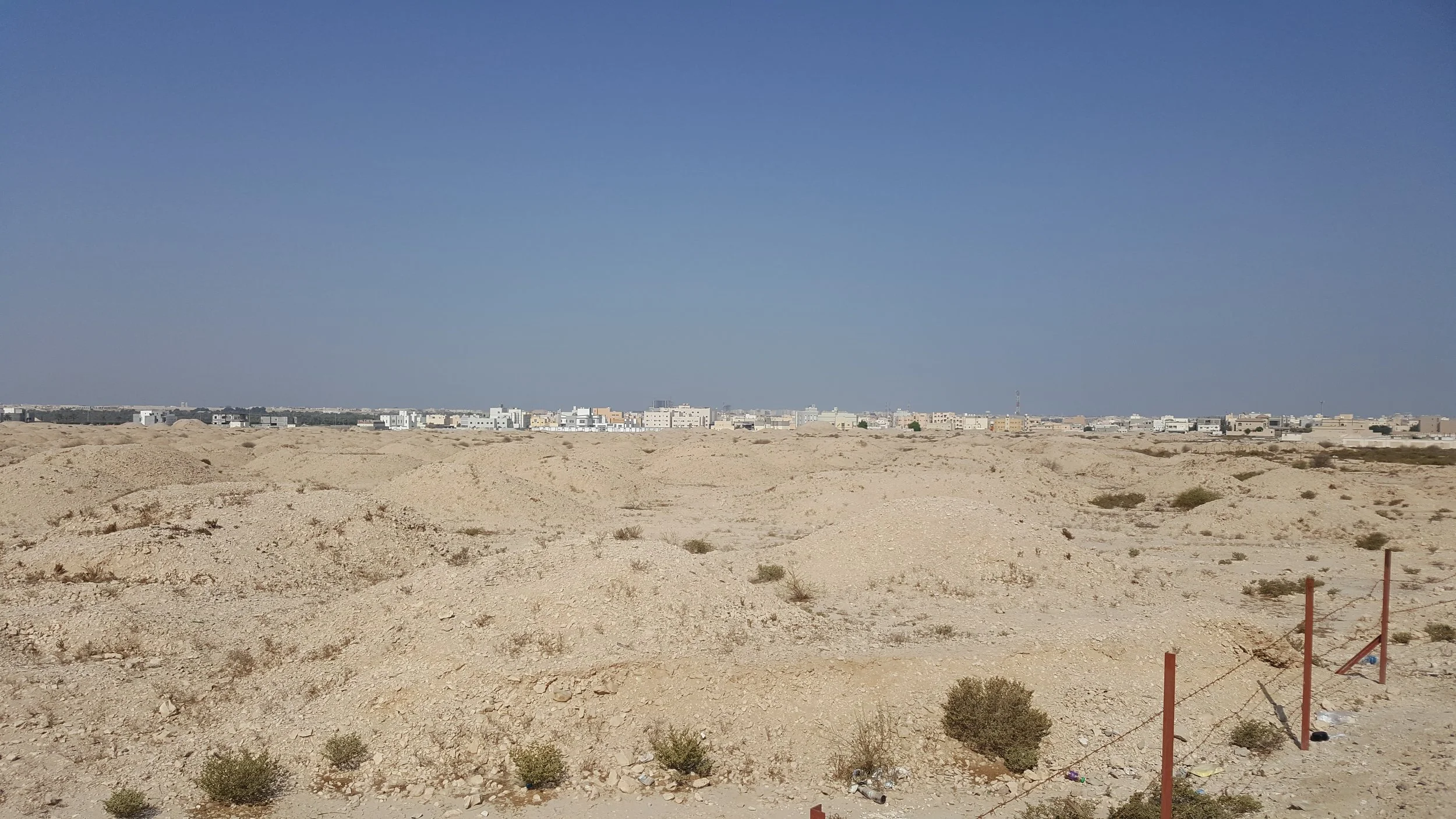
A boundary fence beside the burial field in Bahrain.
The houses beyond the burial fields make that responsibility visible. This is inhabited ground, where preservation sits alongside present needs for homes and services. The UNESCO inscription recognises an extraordinary survival; it does not make the continuing work of caring for it unnecessary. Looking at the field as a whole keeps the smaller monuments within that responsibility too.
The ancient capital at Qal’at al-Bahrain.
Qal’at al-Bahrain helps restore the living world around the cemeteries. The prominent fortress gives the site its familiar outline, but the ground beneath it contains a much longer history. It is a tell, a raised accumulation of successive occupation, with evidence extending back to about 2300 BCE. The large fort visible above belongs to the sixteenth century CE.
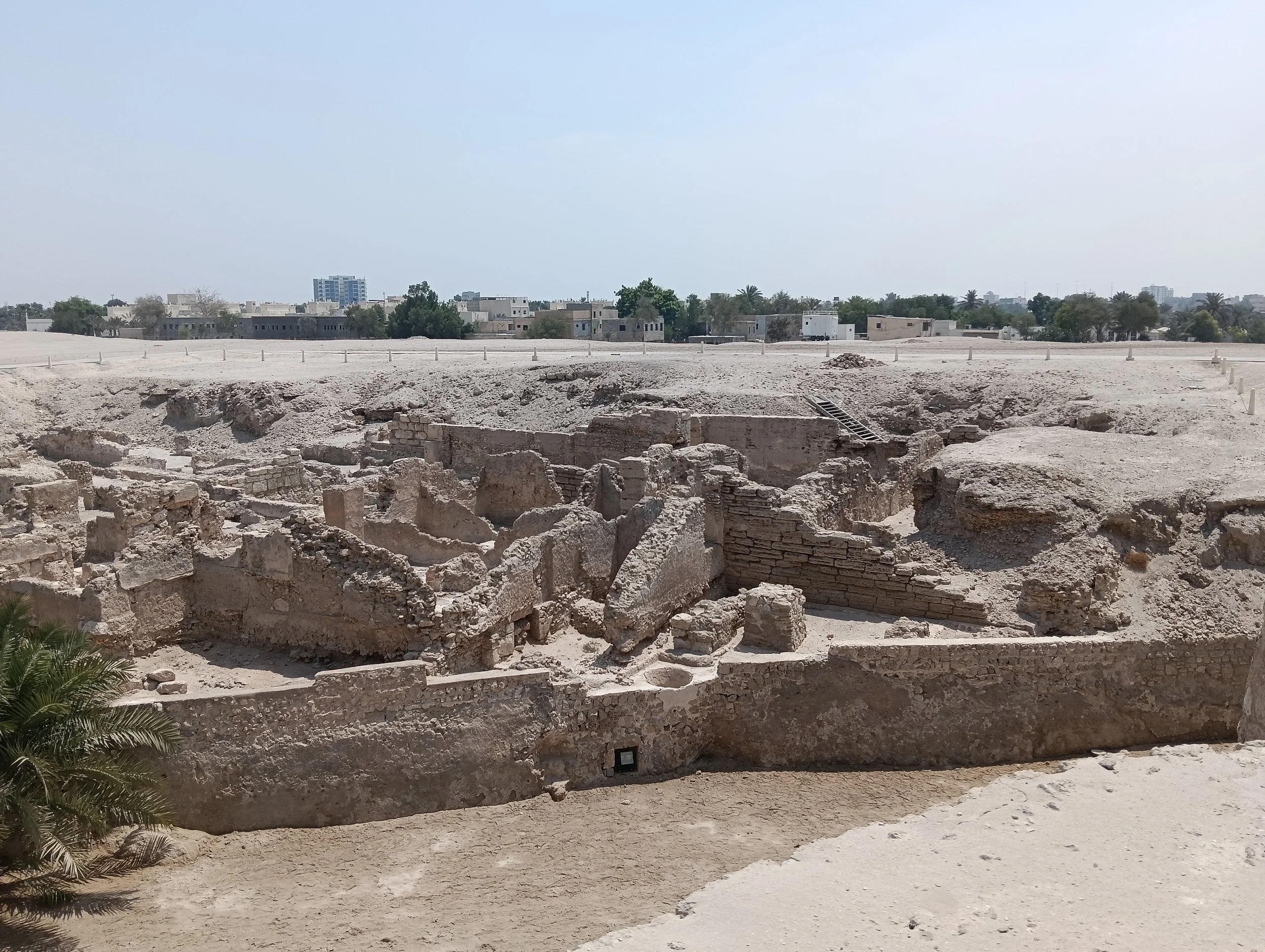
Excavated rooms and masonry at Qal’at al-Bahrain.
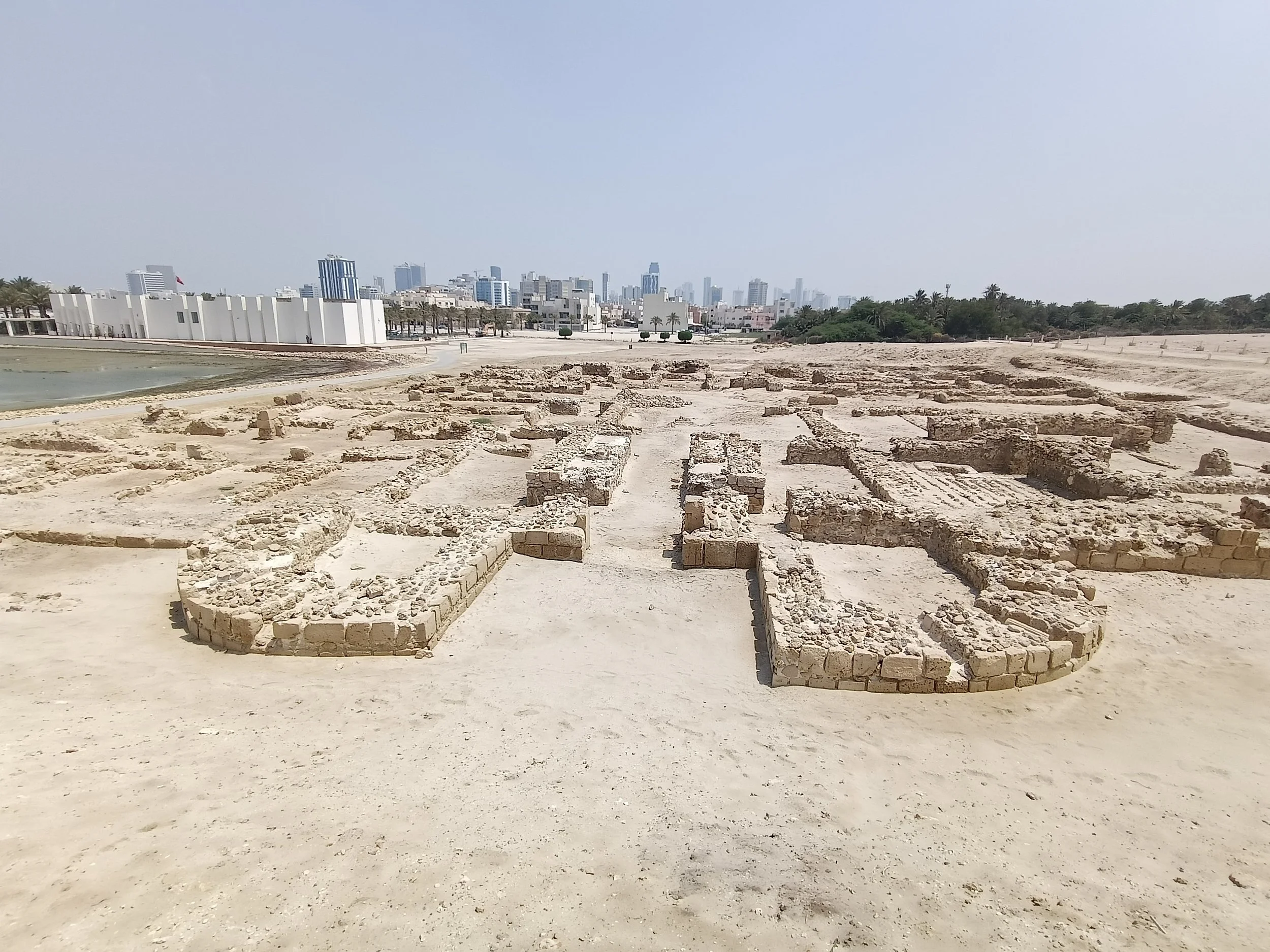
Excavated remains at Qal’at al-Bahrain, with the modern city beyond.
The site preserves several millennia of occupation, but its buildings did not all stand together. The fort, an excavated wall and the ground between them may belong to very different phases. Beneath the later landmark lies the evidence for an ancient harbour and a political centre of Dilmun.
The sea connected that centre to a much wider world. Bahrain occupied an important position in exchanges linking Mesopotamia with the Indian subcontinent. The National Museum’s Hall of Dilmun brings together material from the island’s settlements and temples, including stamp seals and pottery. Such objects return the broad language of trade to things that people could handle.
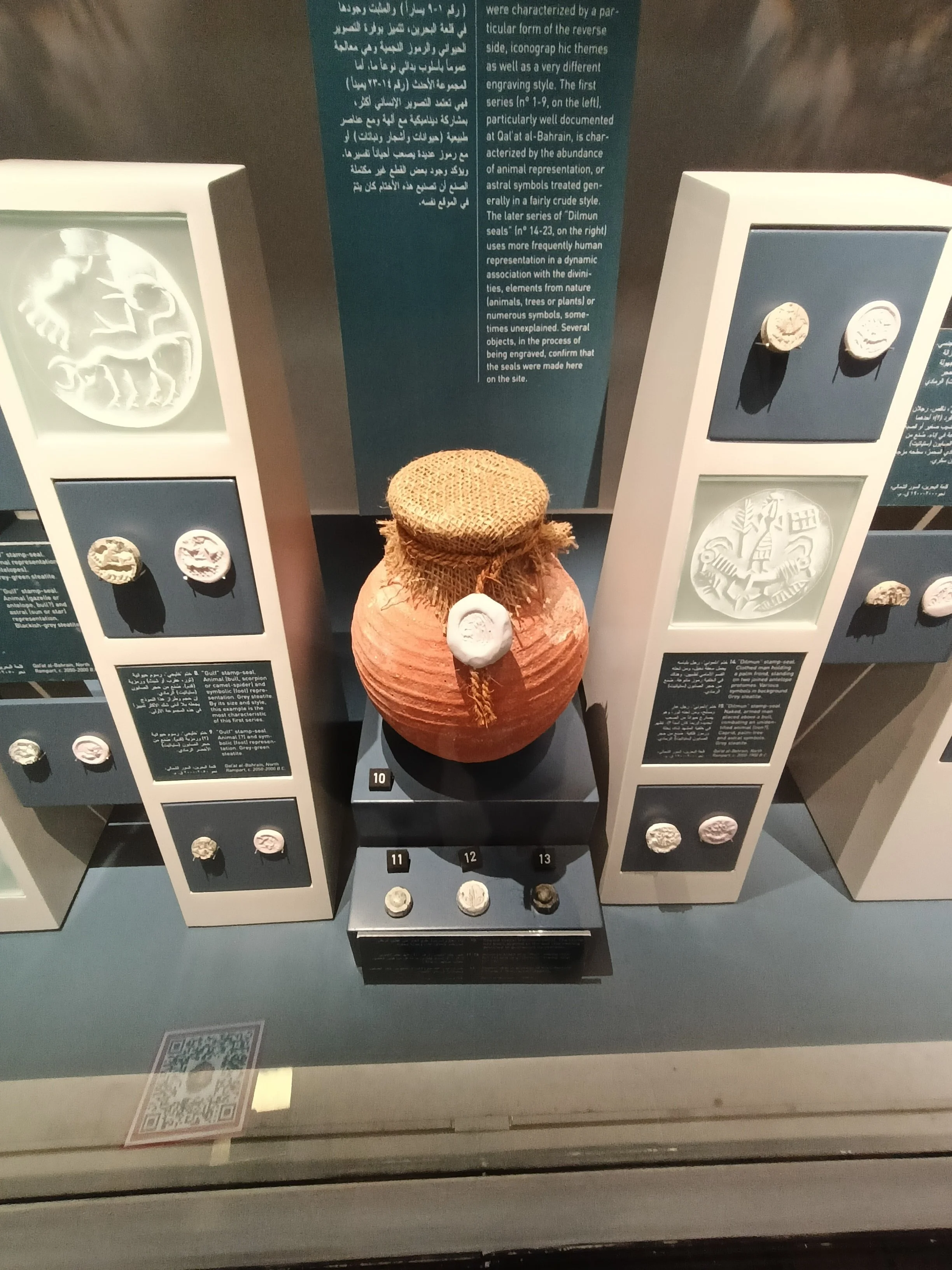
Stamp seals and enlarged impressions, with a museum demonstration of a sealed vessel, at Qal’at al-Bahrain.
A Gulf-type seal in the British Museum’s collection makes those connections more concrete. Excavated at Ur in southern Mesopotamia, it is a circular piece of grey steatite just 2.2 centimetres across, carved with a humped bull and signs related to the Indus tradition. The museum qualifies the signs as a possible pseudo-inscription; they offer no readable account of their owner. The object nevertheless brings several regions into the space of a palm. Its smallness is useful to remember when the distances and centuries of Gulf history begin to feel abstract.
Exchange required repeated practical acts. Goods had to be received and stored; quantities and responsibilities had to be understood. The objects surviving from Dilmun belong within that human activity, even where the particular transaction has vanished. The prosperity associated with the harbours helps explain how substantial resources could also be directed towards building for the dead.
The distinction between periods matters across the Gulf too. Failaka’s Bronze Age remains belong to the Dilmun story, while its Hellenistic fortress belongs to a much later chapter. Bahrain’s later Tylos period likewise should not be folded into the Early Dilmun burial landscape. The connections are richer when their differences in time remain visible.
Houses and a temple at Saar.
At Saar, the scale becomes more intimate. The London-Bahrain Archaeological Expedition’s report on its 1990 excavations describes a settlement of the early second millennium BCE, with work in the temple and areas of housing. Streets and buildings give us another way to approach the people represented in the cemeteries.
Bahrain’s official historical overview describes a main road with smaller alleys and houses built from local limestone. A plan of such a settlement can hold the attention for a surprisingly long time. A turn in a lane directs movement. Walls establish where one household’s space ends and another begins. A doorway connects the private room with the shared street.
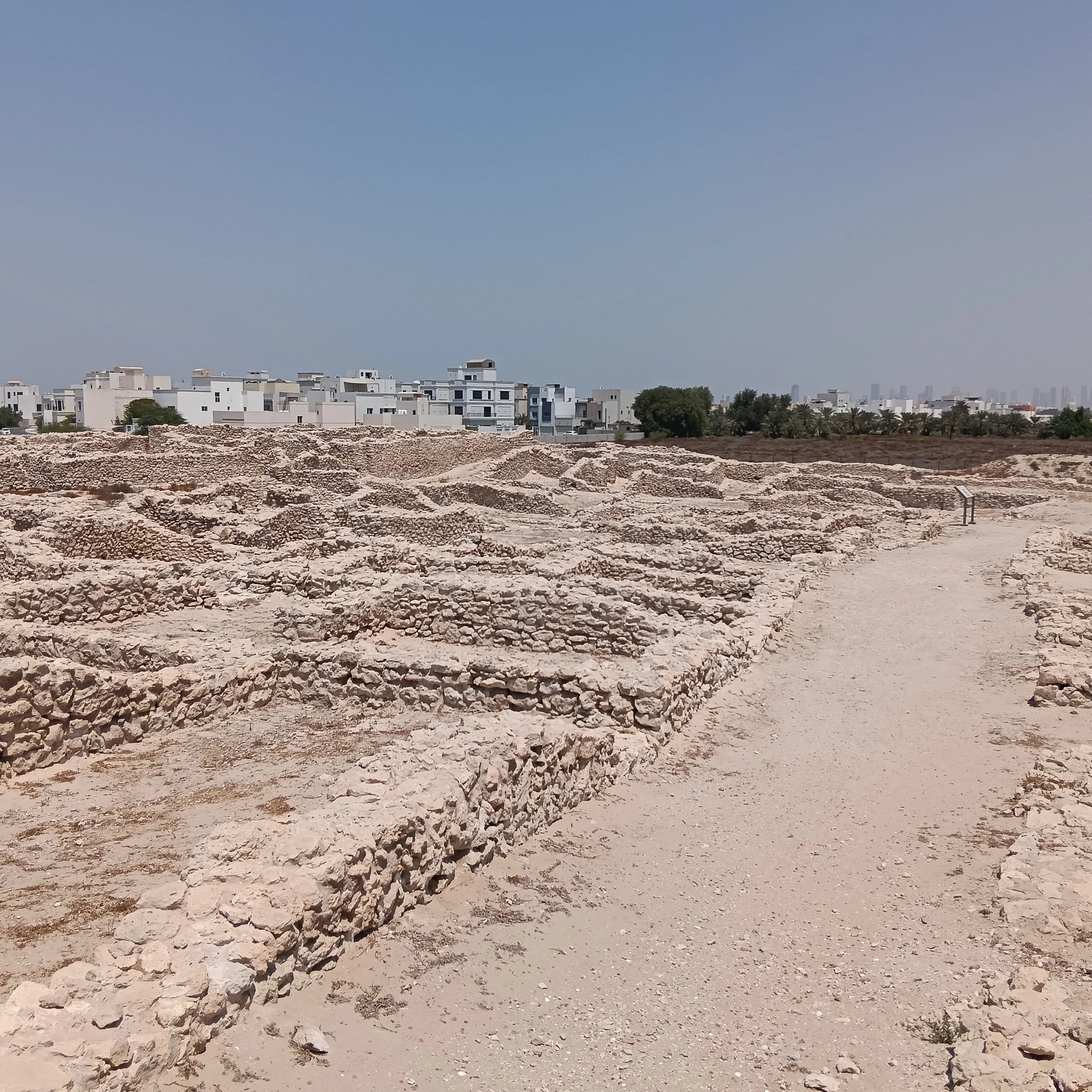
A passage through the excavated settlement at Saar.
The temple places religious activity within this built community. Its survival alongside housing allows belief and everyday life to be considered together. The building is part of the same settlement in which people stored possessions, used vessels and maintained their homes. The relationship between these spaces is more tangible than a general description of an ancient civilisation.
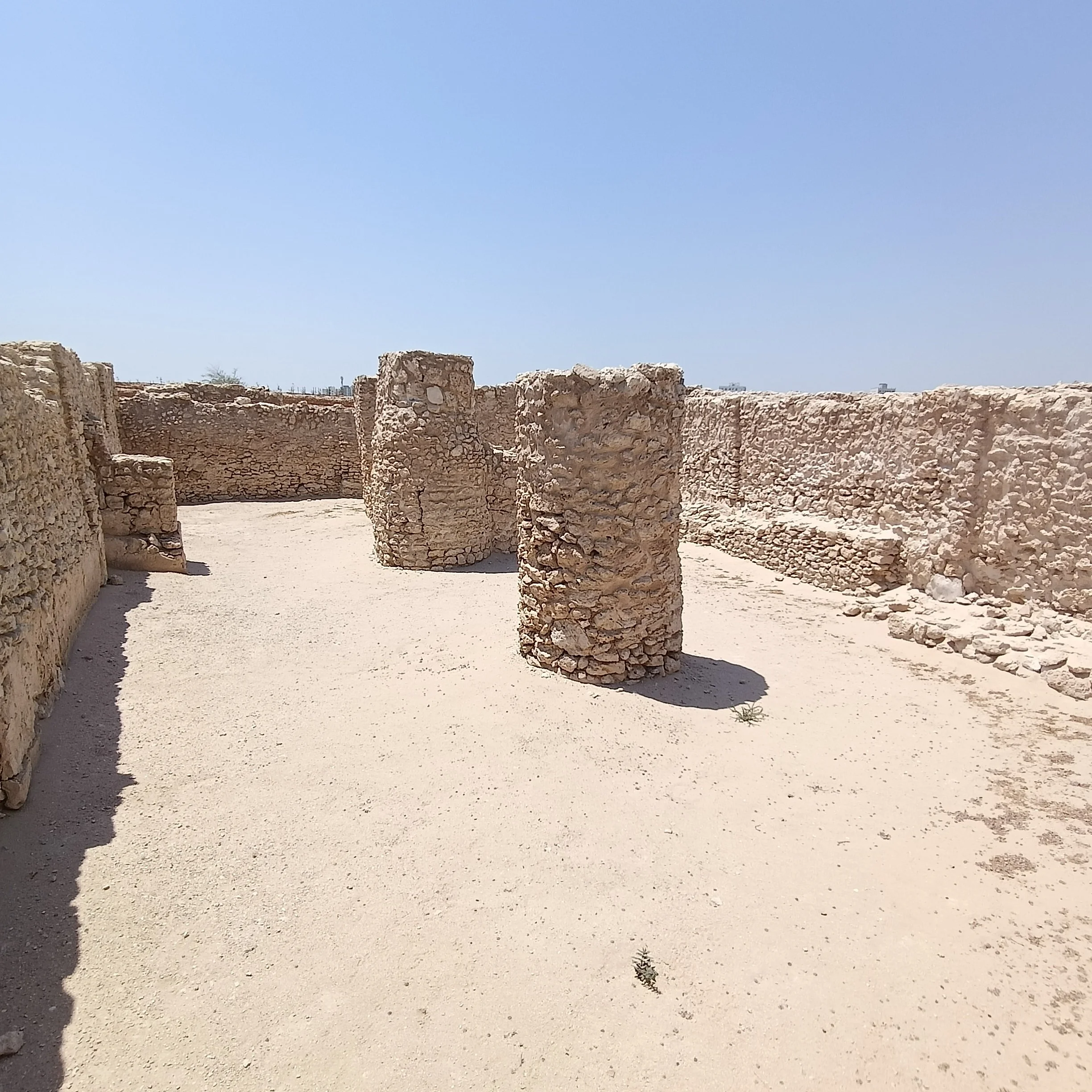
Stone pillars and walls within Saar’s temple.
The remains invite questions about people moving between them. How did the demands of a household fit with those of the wider settlement? How were tasks shared? Excavation can approach such questions through buildings and objects, though a particular family’s conversation remains beyond reach.
Saar was eventually abandoned. The official account leaves the reason unknown. It is an unfinished part of the story, and an important one to leave open. The surviving streets can suggest the pattern of a community without supplying a complete account of its departure.
Water and worship at Barbar.
At Barbar, another part of that inhabited world survives in stone. Three temples were built in succession, with further alterations within that sequence. Their exposed remains belong to a place repeatedly revisited and rebuilt, rather than a single building preserved at one moment. A freshwater spring occupied a sunken chamber within the complex. The association with Enki, the Mesopotamian god of fresh water and wisdom, is an interpretation of the cult, not a surviving dedication that settles the question.
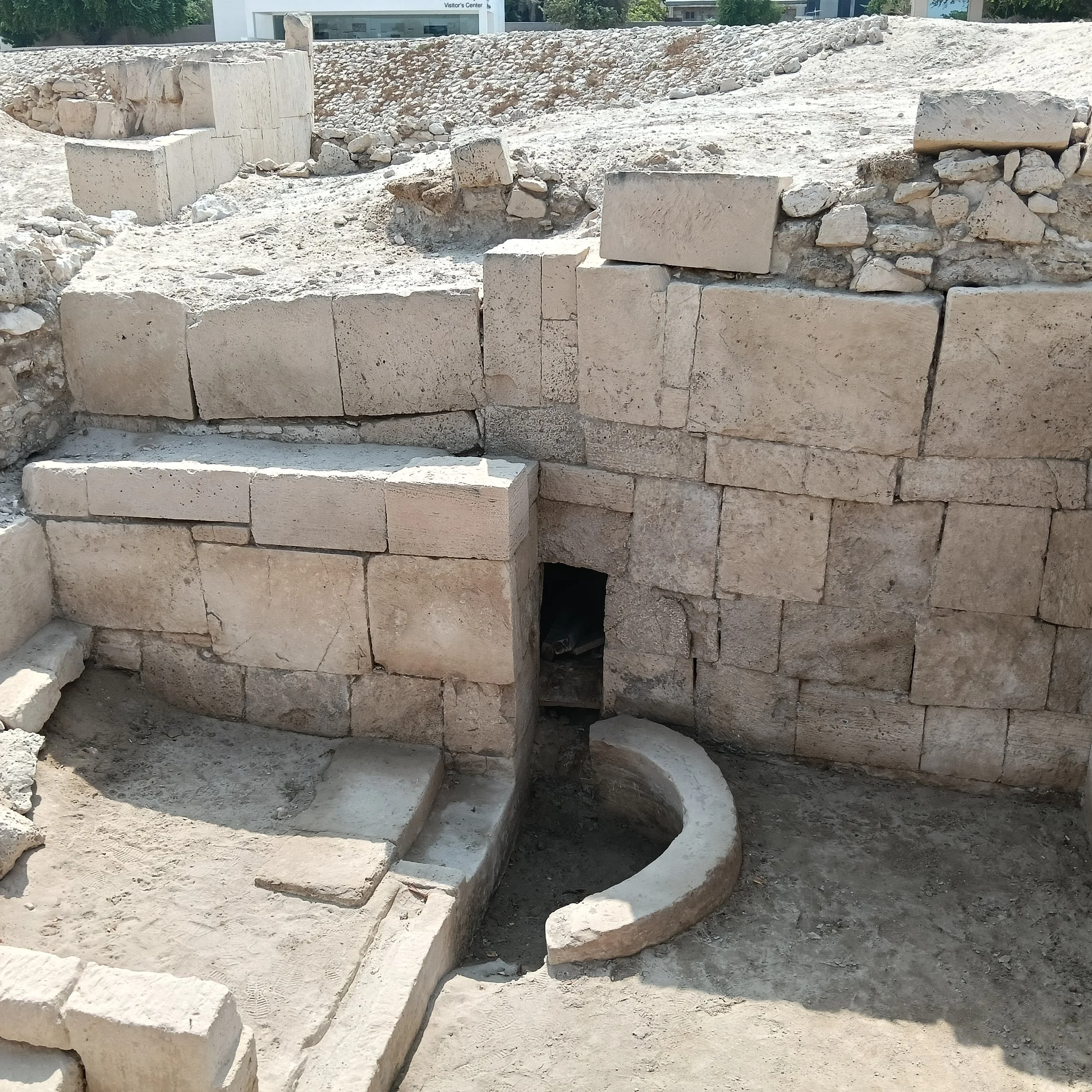
Stone-lined water architecture at Barbar.
The bull’s head of Barbar.
Barbar also gave Bahrain one of its most recognisable ancient objects: a copper bull’s head, found beneath the floor of the second temple during the Danish excavations of the 1950s. Its sweeping horns and broad muzzle give a remarkable presence to a work that belongs to the Early Dilmun world. The museum’s interpretation suggests it once decorated a lyre, a wooden stringed instrument used in ceremony. Similar bull-headed instruments are known from Mesopotamia, making this a particularly vivid reminder that the sea carried beliefs and artistic ideas as well as goods. The possible link with music changes the way we imagine Barbar: a place where people gathered, brought offerings and perhaps heard strings sounding within the temple. The surviving stonework gives us the setting; the bull’s head offers a glimpse of the craftsmanship and ceremony that once animated it.
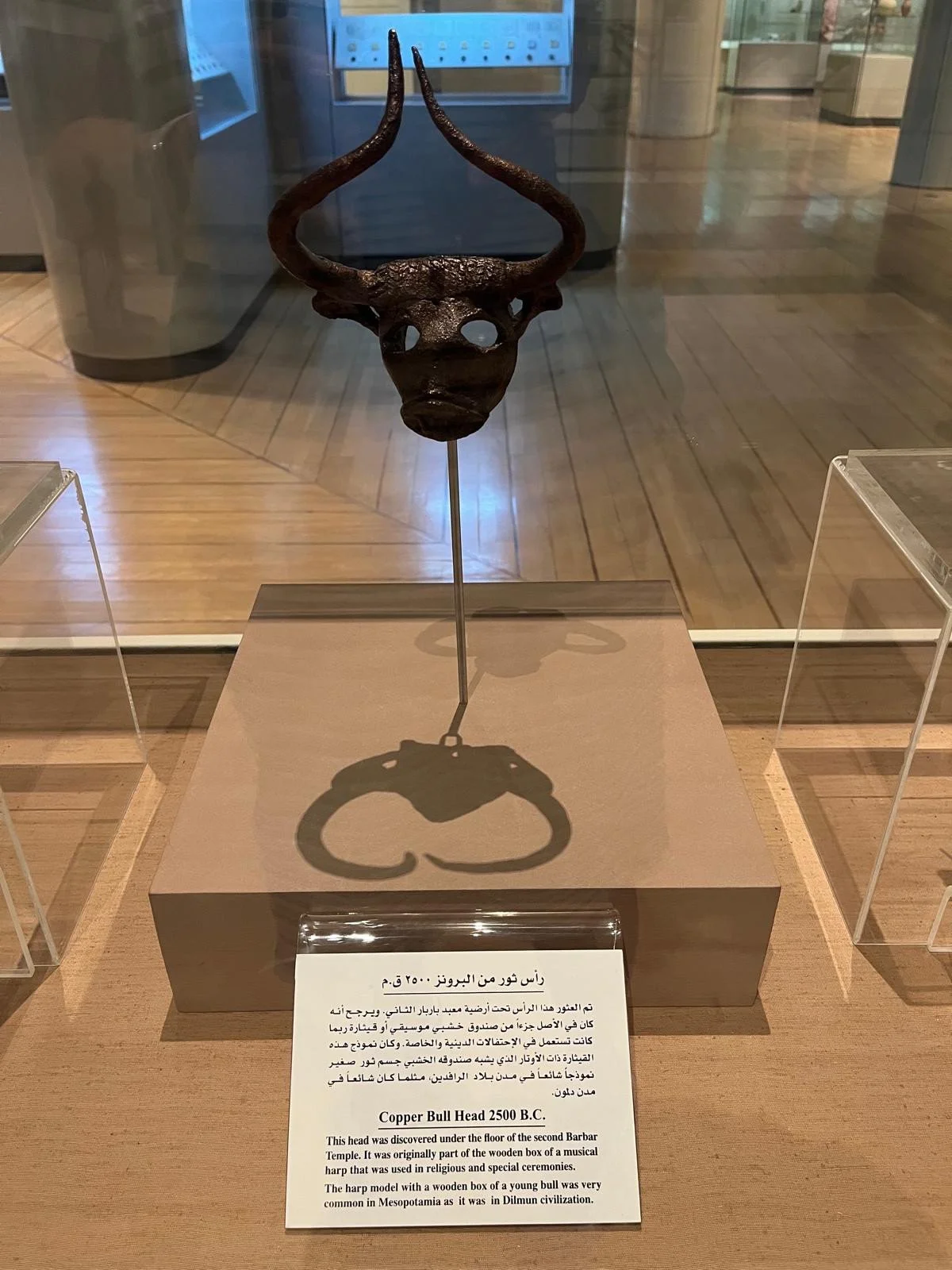
The copper bull’s head discovered beneath the second Barbar temple.
The spring brings the demands of life into the setting of worship. Water supported settlement and cultivation; here it also received an architectural form. Saar’s streets, Barbar’s temples and the burial fields preserve different kinds of communal investment. Considered together, they give the harbour’s wealth a fuller human setting: people made homes, maintained sacred places and set aside ground for their dead.
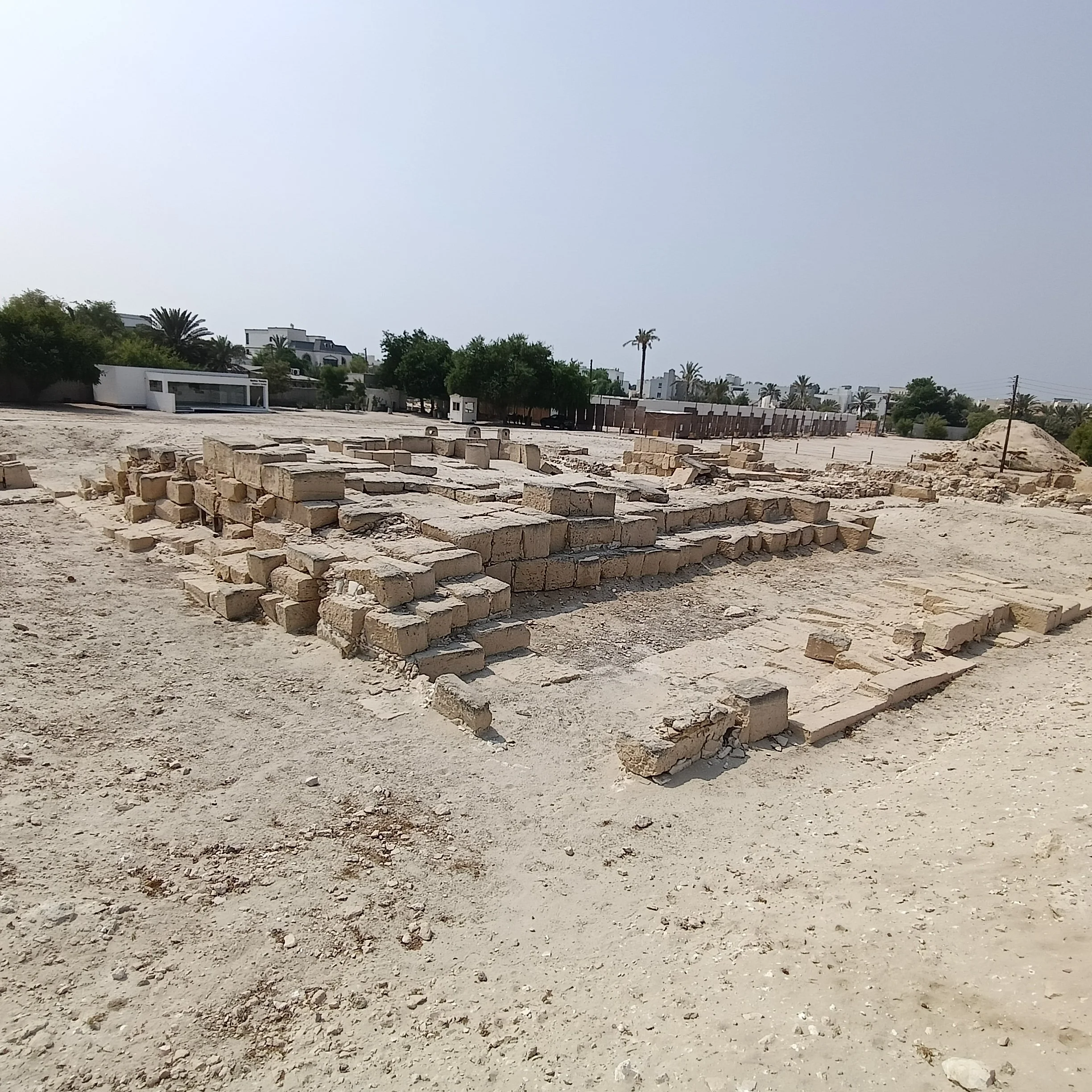
Dressed stonework at Barbar.
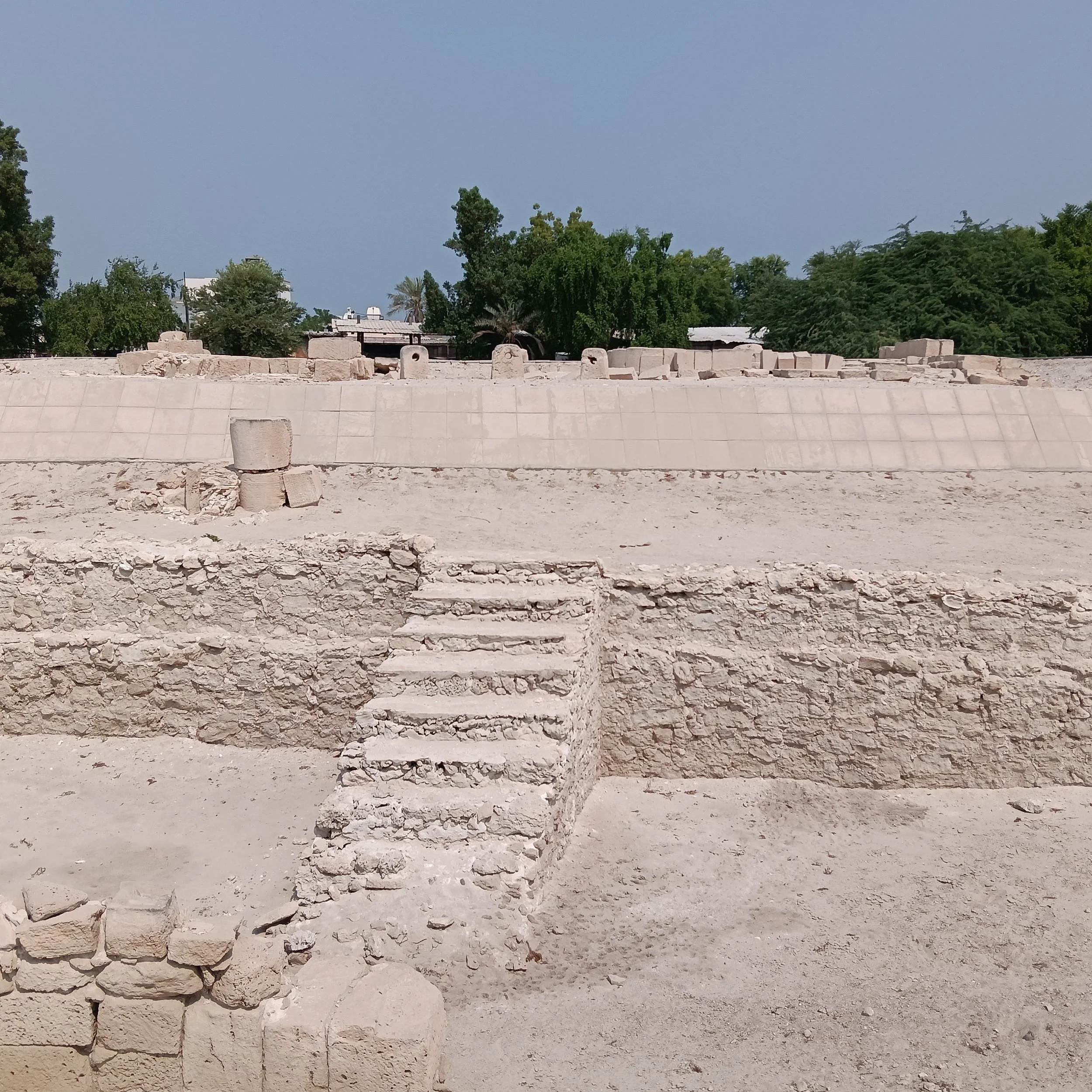
Steps between levels of the Barbar complex.
Echoes and Edges Reflection.
The houses on the horizon bring the responsibility of preservation into the present. The burial fields survive beside living neighbourhoods, where ancient graves and modern homes share limited land. People still need places to live on this island. The mounds need protection within that inhabited landscape.
Preserving them requires choices in the present. Their value reaches beyond the possibility of another spectacular discovery. An unnamed burial, a fragment of pottery or an interval between monuments may add something to the understanding of the people who made this landscape. The quieter evidence needs room to survive too.
The mounds ask for a particular kind of attention. Their scale becomes clearer slowly, as the eye moves from one rise to the next. A single monument suggests the work of a burial. The field suggests generations, while the differences between its monuments reveal something of the society that built them.
Qal’at al-Bahrain, Saar and Barbar help give those generations a world to inhabit. The harbour connects them to distant shores. The settlement provides streets and rooms, while Barbar brings water and worship into the landscape. Together with the burial grounds, they make Dilmun less remote without making its people entirely knowable.
Much of what mattered to those people has gone with them. Their voices, private loyalties and daily concerns rarely reach us. What remains deserves careful looking: the stone they arranged, the objects they used, and the places in which others chose to remember them.
