

 Image 1 of 1
The Complete History of Babylon
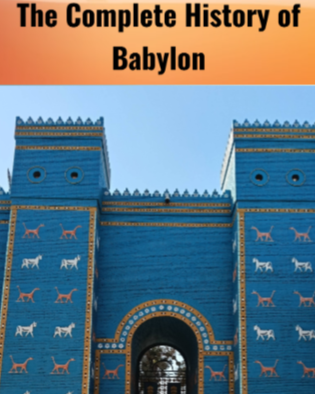
From the first river settlements of Mesopotamia to modern debates over heritage, power, and preservation, The Complete History of Babylon is a definitive, long-form exploration of one of the most influential civilisations in human history.
This book traces Babylon’s story across more than four thousand years, charting its transformation from early agricultural communities into a sophisticated urban system that reshaped law, governance, science, culture, and global thought. Drawing on archaeology, ancient texts, and modern scholarship, it follows Babylon through every major phase of its existence: the rise of city-states, the legal revolution of Hammurabi, imperial expansion under Nebuchadnezzar II, conquest by Persia, long decline, rediscovery by archaeologists, twentieth-century reconstruction, wartime damage, and its status as a UNESCO World Heritage Site in the present day.
Rather than treating Babylon as myth or spectacle, this work examines it as a functioning society. It explores how written law replaced custom, how bureaucracy enabled empire, how astronomy and mathematics emerged from administrative needs, how religion and governance became inseparable, and how trade networks connected Babylon to regions as distant as Anatolia, the Indus Valley, and the Mediterranean. Alongside political history, it delves deeply into daily life: social hierarchy, the roles of women, labour systems, education, art, music, and the preservation of knowledge across generations.
The book also confronts difficult themes head-on. Conquest, colonisation, power dynamics, ethical responsibility, and the modern politics of archaeology are treated with care and clarity. Babylon is presented not as a fallen curiosity, but as a blueprint whose ideas still shape contemporary legal systems, urban planning, governance, and cultural memory.
The Complete History of Babylon
From the first river settlements of Mesopotamia to modern debates over heritage, power, and preservation, The Complete History of Babylon is a definitive, long-form exploration of one of the most influential civilisations in human history.
This book traces Babylon’s story across more than four thousand years, charting its transformation from early agricultural communities into a sophisticated urban system that reshaped law, governance, science, culture, and global thought. Drawing on archaeology, ancient texts, and modern scholarship, it follows Babylon through every major phase of its existence: the rise of city-states, the legal revolution of Hammurabi, imperial expansion under Nebuchadnezzar II, conquest by Persia, long decline, rediscovery by archaeologists, twentieth-century reconstruction, wartime damage, and its status as a UNESCO World Heritage Site in the present day.
Rather than treating Babylon as myth or spectacle, this work examines it as a functioning society. It explores how written law replaced custom, how bureaucracy enabled empire, how astronomy and mathematics emerged from administrative needs, how religion and governance became inseparable, and how trade networks connected Babylon to regions as distant as Anatolia, the Indus Valley, and the Mediterranean. Alongside political history, it delves deeply into daily life: social hierarchy, the roles of women, labour systems, education, art, music, and the preservation of knowledge across generations.
The book also confronts difficult themes head-on. Conquest, colonisation, power dynamics, ethical responsibility, and the modern politics of archaeology are treated with care and clarity. Babylon is presented not as a fallen curiosity, but as a blueprint whose ideas still shape contemporary legal systems, urban planning, governance, and cultural memory.